Friday, September 20, 2024

Mega Man X: A Deep Dive

Well, we've finally made it to the big one. Mega Man X is, frankly, almost a perfect game. The level design is so meticulous throughout that it's been analyzed time and time again, more than any other Mega Man game by a longshot. It evolves the series' formula in so many cool ways, both mechanically and in terms of aesthetics, and comes with a killer rock soundtrack to boot. It's hard to figure what new I can lend to the discussion, but I'll try my best.

Sunday, September 15, 2024

Plok

It's been said that Miyamoto was shown Plok and was seriously impressed by it, to the point that he reportedly showed interesting in publishing it. It's even been said that he ranked it right up there with Mario and Sonic as one of the best platformers of the time, which really surprised me considering how divisive Plok is nowadays. Whenever I hear anyone talk about Plok, all I hear about is either the typically incredible Follin OST or the game's crushing difficulty, so I can't help but wonder, what could have Miyamoto seen in Plok?

Plok has a pretty unique structure for a platformer, but it's a structure that I mostly think works for the game. The main premise is that Plok's flag was stolen so he goes over to the neighboring Cotton Island to chase after it. After getting the flag back, he goes home only to find that a swarm of fleas took over all of his other flags, so he travels across his island of Akrillic, fights off the fleas, and dives into the fleapit to take the battle to them. Simply put, it's basically a revenge thriller with Plok playing the role of a John Wick or a Sisu, and I find that absolutely hysterical. You get to see Plok's thoughts between each level and it always gives me a laugh to see him working himself up over his flags being stolen, it really makes for a uniquely charming and offbeat protagonist that's easy to get behind. But from a gameplay standpoint, this twisty story allows for a game that never really settles. Each of Plok's four worlds has a completely different vibe to it befitting its place in the story. Cotton Island is a lighthearted tutorial, Akrillic has more puzzle-like level design and tasks you with taking out all the fleas in each level, Legacy Island is a short flashback world with a monochromatic look, and the Fleapit is a lengthy final gauntlet with a bleak atmosphere and strictly linear stages.

From a core game design standpoint, I think Plok is generally well-designed and shares a solid amount of elements that I think really would appeal to a big Nintendo guy like Miyamoto. Plok controls incredibly tightly and responsive, and having both a short hop and a big spin jump (which I suppose is quite reminiscent of Super Mario World) makes platforming feel really comfortable. The main hook of the game is that Plok can toss his limbs at enemies, at the cost of having less mobility until he's able to retrieve them. This is probably the most Nintendo-esque aspect of Plok, it's a strong central mechanic with a number of purposes that the game proceeds to flesh out across its campaign. It offers a satisfying way to defeat enemies, but you can't spam or else you'll be left without any limbs for a bit. But it's not until Akrillic when Plok really comes into its own, as it introduces switches that take away once of your limbs. So now there's puzzles revolving around hitting switches, and being left with a somewhat gimped moveset until you can retrieve them. I think the levels in Akrillic are the high point of Plok for this reason, they really utilize your moveset to create some engaging bits of puzzle/action/platforming, with each level tossing a new idea at you and fully exploring it. With these gameplay elements in a vacuum, I can see why Plok could've have gotten Miyamoto's attention.

However, keep in mind that I said in a vacuum. Because while parts of Plok definitely show some brilliance, the final product doesn't really come together in the most elegant fashion. Those cool limb puzzles I mentioned? They only show up in Akrilic, as in just one out of the four worlds. Cotton and Legacy Island are incredibly short and basic, and the Fleapit has you learn to pilot eight completely different vehicles rather than actually be tested on the skills you've learned throughout the game. So in terms of quality, only about a third of Plok is around the 8-9 range, and the rest is around a 6-7. And then there's the difficulty. The thing is, I don't even think Plok is especially hard on a level by level basis. There are a few moments of BS like whenever you have to dodge rolling objects and those stupid doors in Creepy Forest, but most of it is challenging but reasonable. However, when you add in the fact that you have a lives system, and that you can only have a single continue out at a time, and that dying without a continue sends you back about a third of the game, and that there isn't a save feature or even a password feature in what should be a two hour game assuming you don't die, and you get one of the most needlessly punishing video games I've seen for reasons that are completely preventable. What do Ploktinues actually lend to the game besides wasting your time? Why aren't there even passwords in a two-hour long platformer from 1993? I think Plok is a good game overall, but I can not in good faith recommend that you play it without, at the very least, savestates.

On the other hand, though, one area where Plok pretty much completely succeeds, and that's the presentation. Plok has this very colorful and flowery visual style that almost resembles a messier version of the Yoshi's Island artstyle, and it looks pretty great. The highlights are definitely the backgrounds though, which go for this really soft and pleasing watercolor look. And of course, the soundtrack by Tim and Geoff Follin is absolutely stellar. As a matter of fact, I think this might even be their best score period. Most of their work on the NES is known for a single really good track per game. Pictionary and Solstice have the title theme, Silver Surfer has the Stage 1 theme, but Plok has like half a dozen tracks on that level. From the way Cotton Island evolves from a generic bouncy first level theme to a full on rave, to the vibey Beach theme that almost tricked me into thinking it was CD quality at first, to the Hotline Miami-ass Boss theme, to the mystical and proggy Akrillic, to that heavenly drop in the Fleapit theme, Plok's soundtrack easily ranks among the best on the SNES.

Plok is probably the perfect example of a solid 7/10 game. It's a game that certainly had the potential to be something really special, and at times, I can see why someone would hold it up as a serious cult classic or even one of the SNES's best platformers. It has tight controls, an interesting multi-purpose main mechanic, a charmingly goofy story, pleasant visuals, a phenomenal soundtrack, and some really good level design in spots. However, the game also makes a few really preventable mistakes that stops it from elevating itself above that 7/10. The first and last thirds of Plok pale in comparison to the strong middle section in terms of level design, and the godawful continue system and lack of a save feature artificially increase the difficulty from standard retro tough to punishingly brutal. Still, I'm glad I gave Plok a chance because I did overall have a good time with this one, even if there are things I wish it did better.

7/10

Friday, September 13, 2024

Smallville (Season 4)

Well, I'm back to reviewing Smallville. I was out on vacation the last month and couldn't watch TV, but now that I'm back, I can finally get a resolution to that nasty Season 3 cliffhanger. From what I can tell, Season 4 is the end of the high school era of the series, chronicling Clark's senior year. Does it live up to the last three seasons of buildup? Well, mostly.

Season 4 is honestly a pretty polarizing season for me because it has a lot of high points and a fair amount of low points. Let's get the high points out of the way first. Lois Lane finally appears in Season 4 and she is almost immediately the best character of the show. Witty, funny, curious, fast-talking, has incredible chemistry with Clark, Erica Durance absolutely nails Lois right from the get-go and might even rival Margot Kidder as the best live-action version of the character. With Lois comes a generally much more light-hearted tone than last season, Season 4 has a generally much lighter, more energetic, and more comedic feel to it and I actually really enjoyed it. As much as I loved seeing Season 3 put everyone through the wringer, Season 4's comfy senior year vibes really helped it stand out as a fun watch throughout, and the goofier standalone episodes (Transferrence, Onyx) were actually some of the highlights this time. It's also a more sex-focused season which I guess makes sense since the characters are past 17, one episode in particular definitely feels like it's aping Buffy's iconic Surprise/Innocence two-parter. Chloe, as usual, was also a highlight as this season marked the point where she learned of Clark's true identity, and seeing her grapple with this new information made for some of the best dramatic material and character growth of the season.

However, where Season 4 falls flat is in its overarching plot. Season 4 primarily revolves around a pretty drab MacGuffin hunt for three Kryptonian stones. While it does lead to a pretty fantastic finale where they send Clark to the Fortress Of Solitude, the actual lead-up to this moment is miserable for a number of reasons. First off, this whole plot arc ties heavily into Lana getting possessed by a bunch of witches which not only is a level of supernatural completely out of Smallville's usual territory, but it's also just really dumb and screams of the writers trying to find something to do with her. Then, there's Lana's dull new boyfriend Jason who's also involved because his family is also looking for the stones, and honestly I couldn't be arsed to care about them either. The Lana/Jason stuff is such a blight on this season, it's all so boring and stupid and uninteresting, and I'm always tempted to skip to the characters I actually care about whenever they're on screen. I though Lana did get better in the last two seasons, but Season 3 was such a perfect sendoff from her that she feels entirely unwelcome this season. What does she even lend to the show anymore? Chloe and Lois are far more interesting and dynamic female leads who actually grow and mature over the course of this season, and all Lana really does this season is be an annoying drama magnet who, if anything, has regressed since last season in terms of her attitude.

Highlights:

Pariah: Any time Smallville deals with meteor freak discrimination usually leads to a pretty great episode. Pariah feels like a massive turning point in that regard with Alicia's death being a really crushing tragedy that showed off the worst of Smallville. She wanted a chance to just live her life and be with Clark, but the town rejected her and that can definitely hit close to home for people. 

Beyond that though, I adore Chloe's storyline in this episode. I really wasn't expecting her to just learn Clark's identity all of a sudden, but I was especially surprised by her reaction. Smallville totally could've went for the standard liar revealed trope where Chloe gets pissed at Clark, but she tackles things with a lot more maturity, using the opportunity to change her perception of meteor freaks as a whole and deciding to quietly support him until he trusts her enough to tell her. What amazing character development, Chloe rules.

Spirit: Spirit feels like a Season 2 episode of Buffy in the best way possible, it could totally rank among the likes of Halloween or Band Candy. The concept of a prom queen possessing the other characters is great, but what really elevates it is the fact that Smallville doesn't do the easy voice replacement that most body swap episodes go for. It actually goes the length and has its cast act like a prom queen so you end up getting some of the funniest performances from actors like Kristin Kreuk and Annette O'Toole in the whole show. Onyx and Transferrence are great, but this was my favorite gimmick episode of the season.

Commencement: This finale was absolutely nuts, even by the standards of Smallville finales so far. It honestly feels like they crammed an entire season's worth of plot in this single episode, for better or worse. Clark only just now learned he was supposed to get all the Stones, so the episode plays out like an incredibly tense episode of 24 where he races to unite them all before the meteors hit, all the while a timer is constantly shown ticking down. The pacing did feel quite rushed for this reason, but I still think it all came together in the end. We got to see at least a part of the graduation, Clark and Lana properly kissed again (thank god, I thought it was gonna be will-they-won't-they for three more seasons), and the ending even teased the Fortress Of Solitude. I liked that we got rid of the Isobel/Genevieve stuff within the first minute too, Lana's whole murder thing was the most interesting she's been all season. And as usual, there were a metric ton of cliffhangers. What happened to Lionel? Did Jason die? Did the Kents die? Where did Clark end up? What happened to Chloe and Lex in that cave? And what will be the fate of Smallville after yet another meteor shower?

Overall, Season 4 is a bit of a mixed bag for me. At its best, it's a far more consistently fun season than its predecessors, more comfortable in its own skin. The standalone episodes are better than ever, Lois adds a truly welcome jolt of life to the cast, and the finale ranks as the series' best to date. But it's dragged down hard by the weak Stones plotline and the dull characters it revolves around. I still found this season to be a more thoroughly enjoyable watch than the first two, but it doesn't come close to reaching the dramatic heights of Season 3.

3/5 Stars

Other Shows I Watched in 2024

So, now that I've gotten back into reviewing longform TV shows, albeit a lot slower, I thought I'd give a quick summary of my thoughts on the other shows I've seen this year but didn't end up doing a full review for, whether it was because of a lack of material or me just not wanting to write TV reviews at the time.

Superman: The Animated Series
A while ago, I watched and reviewed Batman: The Animated Series and I enjoyed it a lot. Between Kevin Conroy's pitch-perfect performance, the on-point villain gallery, and stylishly gothic Gotham, it quickly became one of my favorite iterations of the character despite the occasional rough episode here or there. However, at the time, HBO Max had temporarily removed a lot of DCAU shows before I could really get started on the next series, Superman: The Animated Series, so I kinda just forgot about it for a bit while I got into Precure. This year, I finally went back to give STAS a chance and it was... fine.

If there's one thing I can praise about Superman: The Animated Series, it gets the characters right. I don't want to delve into the many complexities of how to make Superman "interesting", but I will say that STAS's iteration of the character is well-executed in how it focuses on Superman's innate connection to humanity (and not on how godlike he is and how he has no time for normal people, Snyder). Lois Lane is also surprisingly compelling in how snarky and energetic she is, and Clancy Brown's performance as Lex Luthor is obviously fantastic and chilling. STAS is also just a more consistent show than Batman was. It doesn't reach any of the lows that show did and there's some minor story arcs and continuity that help the show feel less like a strict anthology. However, the big problem with STAS is that it also doesn't really come close to reaching Batman's highs, and I think that's because of how much weaker Superman's villain lineup is. There are some solid antagonists in Superman like Toymaker, Metallo, Lobo, and of course Lex himself, but the average Villain Of The Week episode in this series lacks the same level of pathos that they did in BTAS. As a result, I honestly can't remember many episodes in Superman: The Animated Series outside of the few Darkseid ones, the rest just kinda flew by me.
3/5 Stars

Justice League
I then went ahead and tried to work through the Justice League series... and I kinda got bored by Season 2. I went in well-aware people didn't think Season 1 was very good, so I at least tried to power through it, as hard as it was. But while what I saw of Season 2 was certainly an improvement, I eventually quit out of boredom. My biggest issue with the series is the production values. Coming off of the hand-drawn animation and meticulous orchestration of BTAS and STAS, Justice League's crummy MIDI score and digital animation felt like a massive downgrade, and the action just lacked zero impact. I don't really care about the characters either, it feels like they're all so focused on the task at hand every episode that over a season in and I just didn't have any attachment to them or their dynamic. The fact that every episode was a two-parter meant the pacing was horrendously slow, and while I heard Unlimited doesn't have this issue (along with generally being considered better), I just couldn't bring myself to slog through the first series any further. I think I just don't care much about the DCAU outside of Batman: The Animated Series.
2/5 Stars

Dungeon Meshi: Season 1
Dungeon Meshi is easily one of the most hyped-up anime adaptations of the year. I've heard so many incredible things about the original manga, so I was excited to check out the anime, especially after learning it'd be produced by Studio Trigger. And yeah, it really is that good. Dungeon Meshi stands out among the usual fantasy fare in anime for the sheer attention to detail in its world-building, diverse character designs, and cast of likable but flawed adult characters. It does get off to a bit of a slow start, with the first half of the season being fairly episodic and light, but after a pretty spectacular midseason finale, the second half of Dungeon Meshi's first season really strikes a strong balance between gripping drama, hilarious comedy, inventive dungeon monster recipes, and bonkers Trigger action. With the release of the season finale, it was announced that we'd get a Season 2 to finish up the story, which also makes this the longest Trigger anime and the only one to have more than two cours. Great season of anime, one of my favorite shows of the year, and I can't wait to see how the story resolves in the next season.
4/5 Stars

Curb Your Enthusiasm: Season 12
Curb Your Enthusiasm finally ended and it was, once again, fine. I think the show kinda dropped off after Season 7 (barring the fluke that was the Spite Store season), and while Season 12 isn't as poor as 5, 11, or 9, I did find it pretty unremarkable for the most part. It had some neat cameos like Matt Berry and David Levy, and was pretty consistent and reliably funny throughout, but I wouldn't really call any of its first eight episodes all that spectacular. The arc of Larry going on trial for giving a voter a bottle of water was pretty neat and a big improvement over last season's arc, but it didn't get as much focus as I would've hoped. However, the season did end on a really strong note. Ken/Kendra was easily one of the funniest episodes of the season, it had everything. The hilariously realistic chaos of Larry getting covid, some of Susie's most ruthless insults, Matt Berry being himself, the titular Ken storyline, and Leon coining the term "We too'd". 

The series finale, No Lessons Learned, was as expected, a recreation of the infamous Seinfeld finale. I hate the Seinfeld finale, but it worked here for a number of reasons. First off, it just fits Curb better. Larry David is more blatantly an awful person, the show gets so cartoonish that Larry being put in prison doesn't feel as jarring, and the show doesn't have any clip shows outside of this one. But also, Larry instead ended the finale with him being let out of prison over a clerical error, so we get the "life goes on" ending that Seinfeld should have always had. The episode was called No Lessons Learned and yeah, that's the perfect ending to Curb. Larry has never learned his lesson, and he never will learn his lesson, and that's how it goes.
3/5 Stars

Strange Hill High
Strange Hill High is one of those shows that I kinda just randomly stumbled upon on YouTube only to be immediately drawn in by the character designs, and the more I looked into it, the more I was convinced that this was something I need to watch. Strange Hill High is a British stop-motion animated comedy with an artstyle inspired by Japanese vinyl figures, co-created by Josh Weinstein of The Simpsons fame, with the ever-hilarious Richard Ayoade playing one of main characters. And yes, it is as incredible as that sounds. I can not understate how fresh and unique this series looks, all of the characters boast these really simple but appealing designs that conveys their personality perfectly. The puppetry is consistently ambitious and the production values are high throughout between some elegant CGI integration for mouth movements and frequent destructible scenery, and did I mention the character designs are absolute peak? The figure designs really tap into that early 2000s pop art style I keep raving about all the time (which is apparently called "superflat pop"?), and it creates this strange feeling of nostalgia despite this being a show from 2013.

Of course, great visuals means nothing without great writing, and Strange Hill High is a very funny show. The main premise involves three students who go to the titular high school and investigate weird happenings ranging from a school clock that can turn back time, to..., to... There isn't much of an overarching storyline, but the individual episodes are so inventive and surprising that it's just fun to see what the show tosses at you next. The writing is incredibly sharp and witty, with an impressive joke-per-second ratio and a charming sense of self-awareness. For what's supposed to be a children's show, the writing feels a lot more Adult Swim, in a good way. It's very unhinged and offbeat in a way that constantly catches me off-guard. The cast of wacky students and teachers are immensely charming and likable, especially the main trio who are all wonderfully voice-acted. The perky and naive Becky is probably my favorite character, but the witty slacker Mitchell works as a great protagonist, and Ayoade's performance as Templeton is predictably consistently hilarious. My one gripe with the writing is that some episodes kinda spiral out of control by the end into sheer convolutedness, but even then it remains fun.

While only 26 episodes (which is still a lot by British TV standards), Strange Hill High manages to squeeze so many brilliant episode ideas, top-notch gags, and wonderfully inventive visuals into its short runtime. It simultaneously feels like it came out ahead of and before its time, and was an unpredictable delight from start to finish. I've noticed increasingly more people are became aware of Strange Hill High this year and I'm here for it, it's a series with some serious cult classic potential that you should absolutely watch.
4/5 Stars

Laid Back Camp: The Movie 
Okay, this one's a bit strange. So I watched the Laid-Back Camp movie around when it came out in the west, but since I didn't have as much to say about it, I decided to jot down my thoughts and add it to the next season's review. Little did I know I would be shifted to another medium by the time Season 3 came out (which I still haven't watched yet), so I thought this was as good a place as any to finally release my review of the movie:

Laid-Back Camp seems like it might be a weird series to give a film, considering its general lack of plot, but I like the approach they took. The main plot of the Laid-Back Camp movie is that the cast are now adults. Chiaki calls them together to set up a camping ground in Yamanashi, during which they relive their own high school memories. It's very simple and there isn't much in the way of conflict, but you don't watch Laid-Back Camp for the story. You watch it for the lush backgrounds, calming and optimistic tone, comfy music, and most importantly, the characters. I loved getting to see the whole cast as adults, it's something we rarely see from a slice of life show and the crew went all the way with it. The characters are more mature and adult, but still very much themselves, almost as if they've all completed their character arcs. Rin is still an introvert, but she's less averse to interacting with people. Nadeshiko is still an extrovert, but she's less aggressive about it and her tone of voice has grown more gentle. The ways in which the characters have grown into adulthood makes perfect sense too, like Nadeshiko selling camping goods, Aoi being a teacher, and Chiaki getting drunk. The movie also expands on the show's themes of technology supplimenting how people engage with nature, with the characters branching out towards Zoom calls and FaceTimes for communication, and a PR robot serving as a somewhat important plot point. As a whole, I really enjoyed the movie. It's more Laid-Back Camp goodness, but with a unique twist that helps it stand out.
4/5 Stars

Sunday, September 8, 2024

2024 Games I Played: Bakeru

Continuing this trend of finally being able to play games I previously couldn't this year, GoodFeel's Japan-exclusive Goemon-inspired 3D platformer, Mameda No Bakeru, has gotten a surprise release in the west as Bakeru. I like GoodFeel, I like Goemon, and I like 3D platformers, so I knew this was definitely a game that I wanted to get my hands on once it came. And while I think it has some issues, overall, it's a really fun time.

When Bakeru was first announced, pretty much everyone clocked it as a spiritual successor to the Goemon series, especially considering that a lot of the developers at GoodFeel are ex-Konami, some having even worked on Goemon before. While GoodFeel themselves claimed they weren't directly inspired by it, the similarities are very much there. The main character, Bakeru, has a similar color scheme and design to Goemon. The music has that same energetic Japanese-influenced pop feel to it, the levels are set in real life locations in Japan, and of course, there are mech battles. However, upon really playing Bakeru myself, I will say that a lot of the comparisons are pretty surface level. Goemon always had a bit of adventure game DNA, with some entries even being obviously based on the Zelda series, but Bakeru is a pretty straight-forward linear platformer. Goemon kept the combat simple and breezy, but Bakeru aims to flesh the combat out more. And even on a story level, the cast isn't made of ninjas. Rather, Bakeru is a tanuki and his partner Sun is an inchling. So I wouldn't really say that Bakeru scratched that Goemon itch exactly, though that's not really a bad thing either.

As far as purely gameplay goes, Bakeru is a fairly standard 3D action-platformer, though it executes the tropes of the genre quite well. Bakeru's movement is very polished and reliable, and you get a good amount of optional moves you can pull off like a vault or a side flip. I do wish the game let me map buttons myself since neither layout really felt ideal, but I did eventually become pretty comfortable with the control setup after a few stages. The combat feels like it took a lot of influence from beat-em-ups, you can beat down foes with your drumsticks and have a number of charged moves and even a few temporary moveset transformations to speed up the process. To say that the combat is the weakest part of Bakeru would be a bit harsh since it's not even bad platformer combat. Similarly to the movement, it feels really responsive and polished, and the strong sound design makes whacking enemies feel incredibly satisfying. And those mech battles I mentioned are really, really fun. Dare I say, even better than the ones in Goemon since they let you move around the battlefield in third person rather than stick you in the cockpit. However, I do think that my biggest issue with Bakeru is that there is too much combat with little variation. Enemies are peppered all throughout pretty much every stage and most of them go down in multiple hits, so getting involved in combat often feels like it drags the pace to a halt and makes the game as a whole feel more repetitive. It got to the point that I was running past enemies because I just did not want to waste time engaging with them.

And that's a real shame because Bakeru's greatest strength is definitely the level design. This is one massive platformer clocking in at over 60 stages, but it also manages to keep tossing fun new mechanics and ideas at you until the end, from a level that takes place entirely on a cruise ship, to an autoscroll stage on a parade, to a memorably surreal stage with rotating houses, to an enemy gauntlet atop a rollercoaster, to a Fall Guys-esque obstacle course built into a town. These stages rarely ever challenge you, but they're fun and creative enough that the low difficulty never really became an issue for me. And that's not even getting into the pretty fun vehicle stages, which amp up the variety even further. Despite Bakeru being a generally linear game overall, the main stages are also quite lengthy and sprawling, filled with hidden nooks and crannies, side paths, and eight tucked-away collectibles each. I ended up sinking upwards of a half hour into fully exploring some of these stages, and as a whole, fully completing Bakeru took me a solid 15-20 hours which is really impressive considering the asking price of $40. That being said, I will say I think it went on a bit long by the end. Between the slow combat pace, the long level length, and just how many there were, I did great pretty worn at by the last batch of levels.

Bakeru also has a pretty stellar presentation, which is to be expected from GoodFeel. The 3D visuals are super clean, the characters animate quite expressively, and the colors are bright and eyecatching. But most of all, I love the character designs, they're super cartoony and cute. Even when the game isn't being made out of arts and crafts, GoodFeel remains the masters of games that are just aggressively adorable. My one issue with the visuals in Bakeru is definitely the performance, which dips at a pretty frequent rate. From what I can tell, it seems Bakeru runs at an uncapped 60fps which I generally think is a bad idea. Unless you can ensure that your game mostly runs smoothly, I always prefer a stable 30 over an unstable 60. Thankfully, the dips are never aggressive enough that it ruins the experience, especially with how easy the game is. A pivotal aspect of the Goemon series has always been the soundtracks, which usually blend traditional Japanese music with upbeat pop to incredible effect, and I'm glad to say Bakeru definitely lives up to the legacy in this aspect. I was surprised to find the lead composers this time were actually ND Cube's go-to Mario Party composers for the last few games, and they did a pretty great job here at emulating the Goemon feel with tracks like Tokushima, Kanagawa, and Nara.

Overall, Bakeru is a fun, polished, and surprisingly content-rich platformer that does boast a lot of similarities to the Goemon series, but doesn't quite recapture the same exact feel. While I wish the combat was given a bit less emphasis and the pacing was a bit brisker, the polished controls, consistently inventive and original level design, engaging exploration, and charming presentation still made for a really enjoyable 3D platformer. I wouldn't say this is one of my favorite GoodFeel games, but it's another strong showing from a studio that's never really steered me wrong yet. And between this and the incredibly slept-on Princess Peach Showtime, I've never been more excited to see what they have in store next.

4/5 Stars

Friday, September 6, 2024

Why I Love Bayonetta Origins

As I've stated, Bayonetta Origins was my favorite original game of 2023, but I wasn't sure if it would be an all-timer yet. I think this was one of those games that I needed to sit on for a bit, see how I'd look back on it after about a year. Recently, the official soundtrack for the game finally released and I decided to give it a listen, and before I knew, all the memories suddenly came flooded back. The stunning visuals, the incredible bosses, the countless memorable moments, the powerful emotional payoff that was the final act. Yeah, Bayonetta Origins is an all-timer.

Bayonetta Origins is honestly one of the most interesting enigmas of a game I've seen lately, to the point where I'm still a bit surprised that it even exists. Of course, this is a Bayonetta game that replaces the sex, gore, and constant flashy action that the series is known for with slow-paced puzzle adventure, celtic fairytale whimsy, and light-hearted visuals. But on a larger scale, it also marks Platinum Games going outside their comfort zone that making a far more experimental adventure title than the character action games they usually make, the likes of which we haven't seen from them since Okami. I wouldn't say that Bayonetta Origins shouldn't work, but I will say that it felt like a game that many people just ignored. It's a niche game within an already niche series, who is Bayonetta Origins even for?

Well, me. I'm who it's for. I'm someone who doesn't shy away when expressing if a spinoff happens to do more for me than the main entries. Crystal Chronicles is my favorite Final Fantasy, I like the Mystery Dungeon games more than mainline Pokemon, and while I do really enjoy character action games, Bayonetta Origins clicks with me on a level that the main trilogy just doesn't. I love Zelda-style adventure games, I love unconventional dual-stick control schemes, I love ethereal naturalistic landscapes and uniquely stylistic artstyles, and most of all, I love when relatively notable studios like Platinum Games go outside of their comfort zone and take a huge chance. We really don't get many games like Bayonetta Origins anymore, it really feels like one of those experimental AA PS2 titles, you know? Like Ribbit King, or Stretch Panic, or Chulip, or Robot Alchemic Drive, or of course God Hand and Okami.

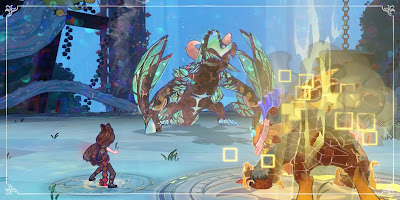
Bayonetta Origins immediately sticks out for its beautiful watercolor artstyle that gives off the impression that you're playing through a coloring book. It's a frankly timeless look that plays to the Switch's strengths, with bold and vivid coloring that look especially stunning on the OLED, and using the console's distinctive aliasing to create a soft and fuzzy look to everything. Frankly, the entire presentation is immaculate, from how all the menus are these dripping watercolor paintings, to the surreal Tir Na Nogs and how they shatter so convincingly, to the dynamic camerawork that knows when to put you right in Cereza's shoes and when to zoom out and let you focus on the game. And of course, the soundtrack is absolutely gorgeous. I did not give it enough credit at first, but Bayonetta Origins' OST is incredible. Most of it keeps things fairly light-hearted with lush orchestral pieces (A New Adventure Awaits, Reach For The Moon), but it always makes sure to take things up a notch for the phenomenal battle music (Tussle With The Tricksy Faeries, The Circus Of Horror, How To Slay A Dragon). And pretty much the entire final act is just wall-to-wall incredible, emotional powerful tracks (Clash Of Wills: Unbound, A New Witch Is Born), culminating in the hauntingly beautiful lyrical ending theme, Together In The Moonlit Forest. The only other ending theme to catch me this off-guard was that of Ico, which is insanely high praise.

Bayonetta Origins has a fairly simple story, all things considered. It's a coming of age story about a young Cereza who ventures into a dangerous forest to prove herself as a witch, only to accidentally turn her stuffed animal into a familiar forcing them to get a lot. You already know that by the end, Cereza and her new familiar Cheshire will get along, and Cereza will become the powerful Umbra witch we all know and love, but it's the way Origins goes about executing this arc that makes all the difference. This game makes sure that Cereza and Cheshire earn their development by the end, and it does so by putting them in a number of memorable conflicts that push their relationship in different directions. It's a real emotional rollercoaster of a game. It starts light-hearted enough as you get to enjoy the very entertaining banter between Cereza and Cheshire, then you get the satisfaction of seeing them finally work together to defeat the Jabberwock, but then they have a nasty falling out that I'd say works as one of the more effective third-act breakups I've seen, but then Cereza saves Cheshire all on her own in quite the tense stealth mission, leading to an absolutely glorious final act that has the two working in tandem to take down Cereza's evil teacher, Morgana. It says a lot that I'm able to so easily recap most of Origins' major story beats almost a year after playing it, it's all just so well delivered.

Man, all that and I haven't even talked about the gameplay yet. Well, don't worry, Bayonetta Origins plays wonderfully. The main hook of Origins is that you play as Cereza and Cheshire at the same time, controlling the former with the left side of the Switch and the latter with the right side of the Switch. Cereza can cast certain spells and walk through areas that Cheshire can't navigate, while Cheshire can get around easier and actually attack enemies. Both the game's platforming puzzles and combat will require you to master using both characters in tandem with each other, and while there's certainly a bit of a learning curve to it, it feels really good being able to master controlling both of them at the same time. Though, of course, you could always have a friend join and make this a co-op game too, it works just as well. The adventure side of Origins is generally pretty stellar, it's always fun to try and get both characters to your destination, and there's a number of fun traversal moves like a sling that lets you fling yourself across platforms. The combat, on the other hand, does take a bit to really get going since you start out with fairly little moves. However, once you start gaining more elemental abilities and working your way up the skill tree, Origins' combat system does develop a lot of depth and a satisfying sense of flow that definitely lives up to Platinum Games' legacy of fantastic combat systems.

In terms of its overworld, Bayonetta Origins has a metroidvania/Zelda sort of approach to it where you learn more abilities over the course of the game that you can use to access areas you've previously missed, and there's a lot of optional collectibles for those who want to explore and backtrack. A highlight for me are definitely the Tir Na Nogs, these challenge rooms that remind me a lot of the Shrines from Zelda, though without any of the filler. Though while the exploration is great, Origins is also able to pull off some really memorable linear segments too. The Fairieland Tower is an early highlight for being this veritable jungle gym with trains to dodge and fun vertical navigation, but there's also the aforementioned rescue mission where you play solely as Cereza. If you're just going from start to finish, Bayonetta Origins is an incredibly tight experience that constantly tosses new visuals and environments for you to explore. But if you want to go for full completion, there's also a lot to dig into, especially if you're also delving into the time trials, costumes, and the postgame Jeanne chapter.

But then, there's the icing on the cake. This is a Platinum Game after all, even Origins has some of the coolest bosses I've fought in years. The boss fights in Bayonetta Origins aren't especially frequent, but they are easily the biggest highlights of the game, perfectly toeing the line between being exhilirating linear spectacles and genuine skill checks. The Jabberwock is an early highlight for how you spend so much of the fight on the backfoot, it's a real difficulty spike that really complements how in over their heads Cereza and Cheshire are at this point. Puca & Affinity stand out for the fun chase sequences that really test your ability to control Cereza & Cheshire at the same time. Lukaon is easily my favorite fight in the game for how he uses all the elemental powers you've learned against you, the utterly bonkers Cereza-only setpieces in the first half, and the incredible face-to-face fight that has you getting back your abilities one by one Okami-style. In any other game, this would be one of the greatest final bosses ever made, but of course, Platinum still wasn't done. The final encounter with Morgana is a bit more spectacle-driven, but between the heart-pumping chase sequences at the start, the trippy antigravity arenas, and the final phase itself which finally gives you Witch Time and lets you go all out as if it was an actual mainline Bayonetta game, it still stands out as an incredibly satisfying and thrilling finale.

Bayonetta Origins was a game I had fallen head over heels for the moment I gave its demo a shot, and I grew to adore it increasingly more on the game went on. On the surface, it's a wonderful adventure game with inventive gameplay, show-stopping bosses, a ton of content, a charming and well-written story, and a beautiful presentation. But even more than that, it's an experimental shot in the dark that fully paid off, taking an established series in a radically different series and executing the shift pretty much flawlessly. Bayonetta Origins is the definition of a sleeper hit, it's an absurdly niche title that came out with pretty much zero fanfare, but it somehow managed to stick with more than any other game I've played last year.

Thursday, September 5, 2024

2024 Games I Played: Pizza Tower

Well... this is awkward.

So I've shouted out Pizza Tower a few times by now, and it's always been in somewhat of a negative light. The developer had previously voiced his intention to not release the game on Switch, and as someone who doesn't own a PC, I'll admit it did make me a tad bitter (the Cocoon incident definitely didn't help either). But as it turns out, they must've changed their mind because as of a recent direct, Pizza Tower is now on Switch! So, like with Spark 3, I finally get the chance to play a game I never thought I would play. Did it live up to the hype?

Of course it did, it's freaking Pizza Tower.

Pizza Tower And Its Inspiration

As a fan of the Wario Land series, I don't think I ever really anticipated the sheer rise in popularity the fourth entry would have these last few years. When I was growing up, everyone seemed to like 3 the best. Wario Land 4 was a really singular platformer for a long time. No prior Wario Land game was quite like it, particularly in terms of the added focus on speed and movement mechanics. While the fantastic Shake It did take a lot of inspiration from its gameplay loop, it had the cost of not being as distinctly weird, surreal, and unhinged in terms of its visuals. The only thing that really held WL4 back was that there just wasn't enough of it, so it probably shouldn't have come as much of a surprise that we'd start getting a bunch of indie games that attempted to build off of the groundwork it laid.

Of course, Pizza Tower and Antonblast are the two most notable ones, and it makes me really excited that I'm able to experience both this year. For as much as those two games get compared, I actually find it interesting to see just how different their approaches really are. Antonblast, from my experience with the demo, leaned more into the exploration side of Wario Land 4. There are an absolute metric ton of collectibles, and it leans heavily on the simple joy of breaking stuff to rack up a high score. Pizza Tower, on the other hand, focuses more on the speed side of Wario Land 4, taking those iconic escape sequences that defined the original and stretching that philosophy across the entire game. It's a great demonstration of how different people can have different takeaways from the same piece of media.

The Obvious Artstyle Praise

So let's get the obvious out of the way, once again, Pizza Tower's visuals are something to behold. The game goes for an absolutely unhinged sketchy style that looks equal parts amateurish and incredibly impressive, with fluid animations that have zero concept of "on model", frequent easter eggs and gags being tossed at you every minute, and nonstop moving NPCs, enemies, and level assets giving a feel of constant motion and action. There are so many little animations and details, from enemies screaming just as you're about to hit them, to Peppino's many anxiety-induced split-second expressions. Pizza Tower had me hooked solely just to see what visual gags would await me in the next level. The music is also pretty great, full of variety and quirkiness. I love how many of the instruments sound compressed, almost like they're coming out of a GBA. I'll elaborate more on some of my favorite tracks as I go through the game, but just know that the whole OST is pure quality.

The Unassuming Tutorial And Its Potential

Pizza Tower starts things off fairly slowly with a tutorial and a fairly easy first level in John Gutter. I'll be honest and say that neither of the stages really hooked me just yet. The tutorial does have a very funny remix of Spider Man 2's memetic pizza song, Funiculi Funicula, and John Gutter does offer a safe place to mess around with the controls, but neither stage really blew me away. The tutorial stage had zero collectibles or ranks to go for, unlike Wario Land 4's tutorial stage, the Hall Of Hieroglyphics. And John Gutter is just kind of boring, with a fairly dull city look that gets drastically overshadowed by a later stage and barely any exclusive gimmicks to speak of. These levels aren't bad, they're perfectly solid introductions to the game, but they definitely don't show off Pizza Tower at its best.

That being said, one thing that these two stages definitely show off is how good the movement is. Peppino's base movement isn't too dissimilar from Wario in 4. You can do a dash/bash move, grab and toss stuff, roll down slopes, but all these moves are expanded upon as well. You can use the dash to enter a Metroid-esque super jump, attack in the air to dive to the ground or gain extra height, and most of your moves never stop your momentum, they all transition between each other incredibly fluidly. This means that you can really enter a sort of flow state where you just start dashing through a stage at high speeds without running into anything, and while that's not something I'm especially good at myself, it feels fantastic to pull off in those rare moments.

Pizzascape, Ancient Cheese, & The Collectibles

The next two levels amp up the complexity quite nicely. Ancient Cheese is one of the less remarkable stages in terms of theming, but it amps up the platforming by having you traverse a bunch of dissipating cheese platforms. Pizzascape is where it's really at though, it might even be the Pizza Tower stage. It's got a unique medieval theme, some banger music, and introduces the game's first transformation. Yep, just like in Wario Land, Peppino gets a whole bunch of situational transformations from interacting with certain enemies, and they usually feel great. 

The Knight in Pizzascape is a highlight though, as it allows you to slide down a slope and dash forward, breaking certain barriers in your path. The platforming puzzles this mechanic creates where you need to find the slope facing in the right direct feel incredibly Wario Land, showing an innate understanding of the level design philosophy behind those levels. And using the Knight to find some of the stage's collectibles felt like serious ah-ha moments. While Pizza Tower is more focused on speed, there is no shortage of stuff to find like the Toppins, a hidden treasure ala Virtual Boy Wario Land, and a bunch of secret rooms hidden in obscure areas, and Pizzascape has some of the better collectible placement in the game so far.

Bloodsauce Dungeon & Speedrun Level Design

Bloodsauce Dungeon seems to be a fairly overlooked stage among the fandom, but I found it to be the point where Pizza Tower really had me sold. This stage lacks many exclusive gimmicks, but it makes up for that with its unique vertical design. You spend the stage running downwards before breaking the Pillar John and dashing all the way back up, and it was this point where the controls finally clicked for me. Just a little bit into that escape sequence, something clicked in me and I was able to dash up an entire room without bumping into anything. This was the first time I entered that aforementioned flow state in Pizza Tower, and it felt really nice. 

However, this stage also shows off just how speedrun-focused Pizza Tower is. Despite the collectibles, Pizza Tower's levels still feel very much designed with speedrunning in mind. They're quite a bit more linear than Wario Land 4's stages, often containing a lot of tight straightaways purely designed for you to run through. Of course, Pizza Tower even has combo and ranking systems that reward you for killing enemies in quick succession. Sadly, I couldn't really get into speedrunning Pizza Tower like I did with some other games. Levels in this game can be quite long and while the movement does feel really good in general, I found myself often misinputting at high speeds with how many options you have. I did not bother going for any higher ranks and honestly, that didn't really impact my opinion on Pizza Tower that much, I still really liked it. However, it did also hit me at points that I felt like I was missing something, I was worried that these levels were made to be run through and I just wasn't engaging with it on that level.

The First Two Bosses: Pepperman & The Vigilante

Pizza Tower's bosses are a bit interesting. I am a bit mixed on them, not because I specifically had bad experiences with them, but because I can see that happening for others. While most of Pizza Tower gives you invincibility like in Wario Land 2-3, the bosses give you an actual health bar. On top of that, they have multiple phases, can be quite lengthy, and you'll have to restart the entire thing if you die. I've played more than my share of games with these kinds of boss fights, though Tropical Freeze stands out the most in this area. It can make the bosses feel like massive impenetrable walls that block off the rest of the game for you, and after dying right at the end of the second phase of my first attempt at the Pepperman fight, I was worried this would happen to me.

Thankfully, that didn't, and I'm glad too because Pizza Tower's fights are really fun. The fight with Pepperman is easily the weakest of the bunch, with the titular character having a fairly basic attack pattern and most of the difficulty coming from the final stretch just flooding you with projectiles that pin you into a corner. But out of anxiety, I tried to play the next fight as early as I could just to make sure I wouldn't get blocked only to find that The Vigilante is one of the most fun boss fights I've played in quite a bit. A Meta Knight-inspired western-tinged duel where you get a gun and are let loose to spam attacks at this fast-moving boss, all the attack patterns being entirely readable and satisfying to dodge, and the fight ending with a quick draw section just as icing on the cake?! All my doubts towards Pizza Tower's boss design were completely erased thanks to The Vigilante, this is a fantastic fight and I immediately became excited to check out the rest.

World 2, Keeping Things Consistent

The first two stages of World 2 don't do much to really push the envelope, but they're still quite fun. Oregano Desert is the longest stage so far and packs in a solid variety of biomes and mechanics, from a desert setting, to small pizza gas stations you hop into to rescue Toppins, to mines with explosive TNT, to a brief section in a UFO. The highlight of this stage though is the fact that it's the first stage to have an its escape sequence in an almost entirely original section of the level, marking a solid difficulty spike. Wasteyard is one of the less memorable levels for me due to its more muted color palette and tone, but it also has a few moments of brilliance like a fun if a tad unwieldly ghost transformation and the escape sequence having you deal with a ghost relentlessly chasing you down as well. It's not until the third stage when I felt Pizza Tower really started to kick it up a notch in terms of level design.

Fun Farm was the stage I was most excited for and it did not disappoint. I knew ahead of time that Pizza Tower would have a cameo from Mort The Chicken, the protagonist of a failed PS1 3D platformer by Ed Annunziata, the guy behind all sorts of quirky projects like Ecco The Dolphin, Mr Bones, and Tiny Tank. The sheer randomness of this cameo is funny on its own, but I guess Pizza Tower had the last laugh because Mort is also an incredibly fun mechanic. He latches himself on your head and you can use him to doublejump, peck at obstacles, and fling yourself off of hooks like a sort of grapple mechanic. He feels incredibly good to use, and as per the usual, grapple mechanics are always a ton of fun in games. The last stage of World 2 is Fast Food Saloon, and while not as showy as Funny Farm, it's pretty fun and frenetic, with a solid amount of mechanics forcing you to go fast like having to beat a rocking horse to some of the Toppins.

Crust Cove And My Own Personal P-Rank

The first level of Floor 3, Crust Cove, may end up being the level I remember the most when all's said and done. It's an incredible stage, all the different elements that make Pizza Tower what it is coalesce into a wonderful whole. It's a lush and vibrant beach stage with a wide variety of environments, fairly open areas ripe for exploration, fun speed-focused mechanics like running on water and the barrel transformation, some of the best music in the game, and exciting chase sequences that have you shot at by a cannon in the foreground. It's easily one of the best stages in the game, maybe even a Top 3 contender. It also drove me up the freaking wall. 

One of the Secret Eyes in this stage is right before a point of no return, tasking you with pulling off a clean run or else you've be launched up and miss it, forcing you to restart the level. I had to restart this stage several times attempting to get this Secret Eye, and it's not early on, it's around the midpoint of the level. And when I was repeatedly playing Crust Cove, I ended up pretty much mastering that first half so I could get to the Secret Eye faster. I even managed to pull off a nearly unbroken combo just after a few tries, and it felt really satisfying. So even though I wasn't aiming to go for a rank, I get it. It feels really good to master a stage in Pizza Tower, and while I don't really have the time to invest in going for S or even P ranks, I can see why others find it so addicting. At this point in the game, some of these collectibles really start to be tied to speed and mastery of the level design, and not just exploration. So I think I may have been wrong earlier, even if you don't go for the ranks and solely focus on collectible hunting, I think Pizza Tower might actually be just as fulfilling.

The Noise Is Cool

Once again, I decided to play the boss early just to make sure I wouldn't be walled off by a difficulty spike, and thankfully, I still wasn't. However, The Noise was a solid bump in difficulty yet again, both due to his random attack patterns and just how busy the screen could be. I had to really focus as to not lose track of everything, and got pretty overwhelmed by the end. I was so scared there'd be a third phase when The Noise pulled out a gun, but thank goodness his girlfriend showed up. While I don't think The Noise's boss fight is quite as original and exciting as The Vigilante's, it more than makes up for that with just how oozing with personality it is. The Noise is such a goofy little dude of a character, from his distinctly cheeky grin, to his erratic attacks, to the giant Noise balloon covering up the background in the second phase. No wonder people wanted to play as him, he's so silly.

Another Moveset?!

Gnome Forest tosses another wild curveball at you by having you briefly play as Peppino's friend Gustavo and his pet rat Brick. It's not just a gimmick though, Gustavo has a fully fleshed out moveset that's almost on par with Peppino's in terms of fluidity and versatility. You could build an entire unique game around Gustavo & Brick, and yet you only play as them like twice in the entire campaign. The novelty of playing as a new character really carries Gnome Forest because the level itself is nothing too special. There's some annoying enemies that are even more irritating to deal with as the somewhat more vulnerable Gustavo, and the sheer length of the stage must definitely make going for a high rank a pain, but otherwise, I thought it was a lot of fun being able to mess around with an entirely new moveset.

The other Gustavo & Brick level, The Pig City, shows up pretty early on in Floor 4, and honestly I think it's a better showcase of what they're capable of despite having less of them. The Pig City is already a fairly fun city level that amps up the griminess that John Gutter only hinted at, while also packing in some pretty hilarious comedic moments and fun gimmicks like grind rails. Halfway through the stage, Peppino gets arrested and you need to play as Gustavo & Brick to save him. The brilliant thing about this part is the fact that Gustavo & Brick utilize the stage's mechanics entirely differently from how Peppino does. Peppino grinds on rails, but Gustavo hangs on them. Peppino uses the balloons to float up, while Brick swallows the balloons to use as an air boost. The police rats try to grab onto Peppino, but they ignore Gustavo in favor of capturing Brick. It's such an unnecessary extra detail and I love it.

Floor 3 Is The Gift That Keeps On Giving

I think Floor 3 might actually be my favorite floor in Pizza Tower, the level quality really took a massive bump. Crust Cove and Gnome Forest were already a ton of fun, but Deep Dish 9 and GOLF are also serious standouts. Deep Dish 9 is a fairly traditional stage with a cool space theming that has you hopping across planets, but its two mechanics in the rockets and bubbles are not only incredibly fun and satisfying to use, but they play off each other really well and has you hopping between both modes by the end. The entire stage just has an incredible flow to it, more than most other Pizza Tower stages even. GOLF, on the other hand, feels like Pizza Tower's Pinball Zone. It's fairly gimmicky and asks you to take things a bit slower and play golf. I was worried this stage would be too gimmicky, but honestly, it's surprisingly fun. The golf mechanics are simple enough to be able to execute at high speeds, pars are pretty generous and getting under par is only needed for a high score, and having to play on unfamiliar courses under pressure during Pizza Time was really tense and exhilirating. Definitely another highlight for me.

Fake Peppino: The Walliest Boss

As usual, I fought the next and penultimate boss the first chance I got. I already knew about Fake Peppino going in, but as always, he's a fairly decent fight with some fun well-telegraphed attacks that slowly amp up in complexity as it goes on. The chase at the end, while easy, was also a pretty nice scare. However, this was also the boss that gave me the most trouble so far, even being the first one to take me more than a single attempt. The second phase has a lot of overlapping attacks that can get quite overwhelming, and while it was satisfying to take down, I think this of all the fights is the one most likely to wall people and that's mostly because of how long the first phase. In between each hit, Fake Peppino sends a bunch of clones to attack you, and you kinda just have to wait for him to show up again. All three of the previous bosses rarely make you wait that long to get in a hit, so it leaves Fake Peppino's fight feeling like a bit of a drop in quality (though I'll admit, it's still more fun than the Pepperman fight overall).

World 4, It's A Mixed Bag

World 4 is a bit of a step down from the last two in general, though it's not all bad. Peppibot Factory was a fairly forgettable stage for the most part, but it is the second one to have a big vertical emphasis, the pizza box transformation is incredibly fun to use, and the goal running away during Pizza Time was a great surprise, definitely one of my favorite tropes in games. Refridgerator-Refridgerator-Freezerator is an ice level so I already knew I was gonna like it a lot, but I especially love the metroidvania-ish structure it took on where you spend the first half of the stage blocked by ice blocks you can't break before getting a powerup halfway through that you can use to access all those areas you couldn't the first time through. 

However, Oh Shit is probably my least favorite standard level so far, packing in all of Pizza Tower's worst traits. You have the worst transformation in the sluggish Cheese Monster, tons of mechanics that either irritatingly push you back, the iffy claw grab, a pretty gross toilet humor theming, and of course, multiple points of no returns that forced me to replay the stage a bunch of times for collectibles. No wonder this was the first stage where I woke up Pizzaface. The few positives I can think of are that the pipes and trash can lids are decently fun to mess around with and the music is really good, but that's really it.

Pizzascare

Floor 5 only has three main levels, and they're easily some of the most interesting of the bunch so I need to talk about them each individually. Pizzascare is definitely the least remarkable of the three, but it's still noteworthy for being the only level to use concepts from a prior one, in this case being Pizzascape. Despite that though, Pizzascare still feels like a completely different beast and I feel it does a much better job at a utilizing a spooky theming than the Wasteyard did. The two main gimmicks are ghosts that you can only defeat after touching an Exorcist, and the King Ghost who follows you and activates objects on your path that can either help or harm you. I like the King Ghost a lot actually, it's a neat premise and introduced a lot of fun and satisfying platforming puzzles, though some of those anchors are pretty cruelly placed. The music is still great, and the whole stage has a lot of energy to it, this is definitely a solid one.

Don't Make A Sound

Don't Make A Sound is a more stealth/horror focused stage set in an abandoned pizzaria where you get chased around by animatronics, so it's obviously inspired by FNAF, a series I have absolutely zero care for or interest in. I was also a bit concerned at first that this stage would be a lot slower-paced, so I went into Don't Make A Sound somewhat doubtful that I'd enjoy it much. I shouldn't have doubted Pizza Tower though, Don't Make A Sound feels less like it's about slowly sneaking around and more about quickly dispatching of enemy cameras before they trigger it along. There's a really fun and satisfying flow to frenetically trying to take out all the cameras in the room, and there are even cases where you need to purposefully wake up the animatronics to progress making sure that even the most skilled player will have to experience a few chase sequences. I like that the Secret Eyes are often hidden behind animatronics forcing you to puzzle out how to get to them, and the finale which has you chased by every animatronic at once before getting a shotgun and turning the tables on them is easily one of my favorite moments in the game. Just a masterful and creative stage all around.

WAR

Well, okay, this might get me crucified. I don't care for WAR.

It's a shame too because I love the set-up. The hilariously blunt title card really sets your expectations, and in theory, blasting your way through a warzone with the aforementioned shotgun all while Hotline Miami-ass music plays in the background sounds like a blast. However, I found this to be the most thoroughly unenjoyable level for a bunch of reasons. So first and foremost, WAR is a level set entirely in Pizza Time. Grabbing the shotgun triggers a time bomb and you have to race to the end while breaking terminals to keep your time up. This isn't a bad idea, Wario Land 4 even did that for its final level, but you are given barely any leniency here, especially if you go for the collectibles since time continues to tick down when you're in the Secret Eyes (this is the only level that does this too). And since you need to collect every Secret Eye in one run, you really have to commit too. Pizza Tower can be a pretty tough game so I'm not exactly complaining that WAR is hard, but it felt really trial-and-error compared to the other escape sequences. I didn't feel like it was really possible to do this is one go, since there are so many easy mistakes to make that could cost you the stage.

And while the guns are incredibly fun spectacles in the Vigilante fight and Don't Make A Sound, WAR really shows how limiting they can be since there's a number of moves like the grab and uppercut you can't do while holding the shotgun. This makes Peppino's movement feel, in turn, less fluid and it makes WAR feel less like a final level testing you on everything you've learned, and more like it's forcing you to adapt to this gimped moveset. I don't mean to keep ragging on this stage that pretty much everyone seems to love, but I found it to be easily the weakest one in the game. Even separated from its main hook, I found WAR's level gimmicks like the landmines, homing missiles, and Peppino clones to be pretty unremarkable on their own, and with zero incentive to explore, I also found the stage fairly lacking in substance. It also doesn't help that I feel a certain other level does what WAR did even better, but more on that in a sec.

The Finale

Thankfully, while WAR could've risked me ending the game on a sour note, Pizza Tower's finale is fantastic and sticks the landing hard. The fight against Pizzaface suffers from the same central issue that all the other bosses had, it's absurdly long clocking in at a whopping seven phases. However, its difficulty was also incredibly fair which helped the fight remain satisfying and climactic to take down. The Pizzaface fight tests you on pretty much all of your combat capabilites, with the fairly simple first phase having you toss enemies at him, the second phase using the gun, a boss rush with truncated versions of all the previous fights, and a cathartic final phase that tests your patience. It's got a real sense of spectacle too, from Peppino snapping and muda-muda-ing all the previous bosses, to the final blow having him suplex Pizzaface into the tower itself. I think The Vigilante might still be my favorite fight overall, but this is a fantastic final boss.

And it's not over yet, because after Pizzaface comes the true final level, the Crumbling Tower Of Pizza, which is actually my favorite level in the game. If you know me, you know that I love it when final stages feel like a victory lap that test everything you've learned and Pizza Tower absolutely nails this trope. This is another stage that you spend entirely in Pizza Time (though unlike WAR, there's a flat time limit with a decent amount of leniency), and it has you dash down the tower through pretty much every prior level. You get to pass through all the hubs, picking up the NPCs you've met along the way, and you get setpieces with pretty much every single prior mechanic. While I didn't find this stage all that difficult, especially compared to WAR, it felt incredibly satisfying and ended Pizza Tower on the best note possible.

And if you're wondering, I got a Not Bad rating which I'm pretty satisfied about.

Conclusion

Overall, Pizza Tower really is a fantastic game, and a wonderful love letter to the Wario Land series that shows a genuine understanding of their design philosophies. Even if the focus on speedrunning wasn't really my thing, the incredibly fluid movement, varied level design, satisfying collectible hunting, surprisingly fun bosses, and stellar aesthetics still make for one of the best platformers I've played on Switch. With all the hype, it's always a toss-up if a game will actually live up, but Pizza Tower thankfully manages to live up to its gargantuan cult status.

4.5/5 Stars