Showing posts with label Top 100 Games. Show all posts

Monday, October 28, 2024

2024 Games I Played: Sonic X Shadow Generations

Despite being a massive Sonic fan, there are two really important games I've sadly never gotten the chance to play, Sonic Unleashed and Sonic Generations. Unleashed getting re-released is pretty much a pipe dream at this point, but Sonic Generations just got a port complete with an entire second campaign focused around Shadow. I actually really like Shadow The Hedgehog, the game, so seeing him get another spinoff is really cool, and since I haven't even played the original Sonic Generations, this package is basically going to be two new Sonic games for me. Will Sonic Generations live up to all the hype? Will Shadow Generations be better than the last few 3D Sonic games we got? And most importantly, will it all run well on Switch?

Sonic Generations came out in a renaissance era for the Sonic series, when it finally seemed like the games were starting to "get good" again with the release of Sonic Colors. Of course, nowadays, games like Black Knight, Unleashed, and to a lesser extent Shadow 05 are being held up in a greater light challenging the whole concept of "Sonic's dark ages", but Colors and Generations really were the games we needed at the time. Polished, smartly designed, and focused experiences that proved Sonic Team knew what they were fucking doing. I still love Sonic Colors to bits, despite how divisive it's gotten lately, so I felt primed to like Sonic Generations and I'm glad to say that it still managed to surpass my expectations. That being said, let's quickly get the weakest aspect of both games out of the way. Because yes, the story is pretty weak. It can be a bit cute in the way it subtly references the series without doing a straight-up reference, but its minimal approach to dialogue and characterization also stops it from being a true celebration of Sonic as a series like the rest of the game is. This remake does actually include rewritten and re-recorded dialogue that tries to flesh out the narrative in whichever ways it can, but since they kept the animations the same, the bad lipsync only ended up taking me out of the story more. It would've been nice if Sonic Team bothered to at least add an option for the original cutscenes so I can experience the game as it was intended, but as Sonic Colors Ultimate indicated, I guess they're afraid of customization in their remakes.

But hey, not every Sonic game needs a great story. I'd take a Sonic game with a weak story but great gameplay over the reverse any day of the week, and I'm pleased to say Sonic Generations has absolutely incredible gameplay. Generations has you visit nine areas from the series' past and play through them both as a boost-style Modern Sonic and a Genesis-style Classic Sonic. I went in expecting the Classic Sonic bits to be the easy lesser half and... well, that's not exactly wrong, but I was surprised at how much I enjoyed these parts regardless. Classic Sonic's gameplay in Generations is not a pixel-perfect translation of the way the Genesis games played, but that's not something that necessarily bothers me, I love the Advance games after all. Instead, Classic Sonic's gameplay is mostly focused on the spin dash, which lets you go a lot faster than in most other 2D Sonic games. You're told very early that you can spin dash up ramps to gain some serious height, and it's not very long until you're actively required to use this move. It lets you take shortcuts, completely break certain stages, and it's generally really fun to do. The game even adds a dedicated spin dash button so you don't even have to crouch to pull off this move off. Sonic X Shadow Generations also adds the drop dash, and I don't think there's another Sonic game better suited to this addition.

That being said, Modern Sonic is easily the highlight here. Most of my experience with boost gameplay has been with Colors and Frontiers, so I'm used to having a double jump, automated drift and quick step sections, and needing to collect capsules to boost. It was a bit of a learning curve at first, particularly the lack of a double jump, but after playing for a bit, I really clicked with this gameplay style. Modern Sonic controls incredibly well in Generations, he's tight, responsive, and handles impressively well at high speeds. It's a joy to get better at his stages, and learning when and how to use every move in his toolkit. The drift in particular is shockingly easy to control in Generations considering how much of a reputation this move tends to have for being really slippery and over-sensitive. I have seen a fair amount of criticism towards the controls here, some saying that it compares negatively to Shadow and that the game is "poorly aged". First off, can Sonic fans stop turning against the most beloved games just as I play them for the first time? It happened with Colors too and I'm still not over the sudden switch-up on that game. But beyond that, I guess I'm just not someone who tends to think of games as "poorly aged" a lot of the time. If a game was well-received or even beloved when it came out, it was obviously liked for some reason, and maybe I need to take the game on its own terms to find that reason rather than expect it to show up the moment I press start. Like I said, Sonic Generations has a learning curve, like most Sonic games. Once you get past that curve, it feels incredibly natural.

That being said, I do kinda see where people are coming from, Sonic doesn't have the same freedom of movement as Shadow in his campaign, but that's because they're two different gameplay styles. Shadow's gameplay is primarily derivative of Frontiers, and as such has to accomodate both an open environment and linear level design. Sonic's gameplay is purely focused on linear obstacle courses, so it's more focused on allowing you to quickly react to the stage. The levels in Sonic Generations are designed with Sonic's controls in mind, so Sonic controlling differently than Shadow in a vacuum doesn't really matter to me. You know, with as much as I've raved about the Adventure era games, you'd think I'm not huge on the boost formula but that couldn't be further from the truth. I actually really like the boost gameplay, at least in concept. It's this unique blend of platforming and racing game that feels unlike most other platformers on the market. At its best, it blends this really visceral sense of speed and spectacle with that classic Sonic depth of slowly mastering a level and learning its layout, and it fits the character really well. Of course, this all depends on the execution. Forces has all the spectacle but none of the depth because of its linear level design, and Frontiers has more sprawling levels but a pitiful sense of speed. But when done well, there is a lot of merit to this approach to game design. And thankfully, Sonic Generations is an example of a game that executes on this formula very well.

Sonic Generations's level design is absolutely stellar. Dare I say, it has some of the best designed Sonic levels I've ever seen. Like, for starters, they're incredibly dynamic and well-paced. Each stage flows from each memorable setpiece to the next impressively fluidly, and it helps them all feel like real tangible places. Classic Sonic's stages implement a lot of fun 2.5D elements from skewed camera angles to multiple layers, and Modern Sonic's stages do an incredible job at taking iconic stages from series past and realizing them to their absolute greatest potential. There really aren't many weak stages in the game, I can think of so many standouts across both Sonics. Chemical Plant Modern gives a much darker edge to an tried-and-true stage, both versions of Speed Highway extend one of Adventure's best stages in some really creative ways, the City Escape stages play around with the iconic truck setpiece in some very silly ways,  Crisis City's stages perfectly blend speed and challenge, and Rooftop Run is just... perfect. There's no other way to put it, these are perfect Sonic stages in terms of their layout, pacing, and joyous atmosphere. But on top of that, Generations' stages are absolutely sprawling. Each stage is filled to the brim with shortcuts and alternate routes, even the 3D ones. The brilliance of this game is that the first run of each stage is probably going to be pretty rough, but you'll be constantly seeing other routes that you missed out on taking. You decide to play the stage again trying to take those routes, only to find even more alternate routes. The cycle goes on and on, you start to realize how every enemy is perfectly placed to help you gain some speed, you notice the way all the different paths intertwine, and you find all the various collectibles hidden around until finally, you've mapped out the perfect route through each level out of pure curiosity. No other Sonic game I've played feels so meticulously designed to encourage the player to speedrun, and Generations had me replaying stages over and over again solely to get a better time. It's the perfect balance between the twitch-based platforming and the complex routing that boost style Sonic games should ideally be built upon.

The only element of Generations that has me a bit unsure are the boss fights, as per the usual. Sonic games don't tend to have the best boss fights in general, and to give this game credit, it's got one of the better lineups out there. Generations' boss fights are flashy and dynamic, often having multiple phases and cool, unique mechanics exclusive to each fight. At their best, you get fights like the revamped Perfect Chaos fight and the frenetic encounter against Silver. However, I feel like most of Generations' boss fights also have something preventing them from being truly incredible. The Death Egg Robot has a great first phase but getting its arms to hit the mines without blowing yourself up in the second phase feels pretty finicky, Shadow's fight has a cool concept but his inconsistent speed just screams of rubberbanding, and Egg Dragoon is mostly an incredibly fun and challenging fight except for the fact that you don't seem to be able to turn properly. And then there's the Time Eater. Frankly, it seems Generations' endgame as a whole is the most criticized part of the game but I really don't think it's that bad. Planet Wisp is one of the weaker stages for its length and lack of 3D, but it's still as well-designed of a stage as all the others and a solid final challenge. If it's the lowpoint of Generations, it just shows how stellar the rest of the game is. And the Time Eater, while way too short and boasting some unclear attacks, honestly can be pretty fun if you know what you're doing. Emphasis on if because the biggest issue with this fight is that Generations doesn't bother explaining at all how the Super Sonic mechanics in this game work, I had to look up a guide to actually have a shot at beating the guy.

Another criticism people have with Sonic Generations is that it's fairly short and yeah, that's also true. With only 18 stages and seven bosses, you can easily blitz through this game in 2-3 hours if you want to. That being said, Sonic Generations also has a solid amount of side content that pretty much tripled that playtime for me, and a lot of it is genuinely worth doing. As usually for the Boost games, there is a bunch of collectibles like the Red Star Rings that encourage you to replay stages and try out different paths. This port adds in another collectible in the Chao who are also fun to seek out. The real meat in terms of the side content, though, are the challenge acts. Each area has 10 meaning there's a total of 90 challenge acts, and a vast majority of them are really fun. Many of them have entirely unique level arrangements which helps them feel fresh, and there's a few varied mission types like races and tutorials for certain skills. But my favorite missions easily are the character missions, which have you partner up with one of Sonic's friends and use their abilities. It's not the same as actually playing as them, but hey, it's still fun to have characters like Rouge, Blaze, and Espio hang around for a stage. Beyond that, my other favorite bit of side content is the unlockable library of music tracks from across the series that you can play in pretty much any stage, almost like in the Smash Bros games. It's such a fun addition and being able to swap to a different music track helps to make repeat attempts at perfecting a stage feel a lot more tolerable.

So yeah, I absolutely adored Sonic Generations. It quickly became one of my favorite 3D Sonic games of all time, probably second place to the first Sonic Adventure. It has a level of polish in both its design and its presentation that feels pretty unparalleled within the series, and it left a high bar for Shadow Generations to beat. I'll be honest and say that I was a bit skeptical for Shadow Generations, even with all the genuinely promising footage that was being shown, it all just felt a bit too much like Sonic Frontiers, which was a game I didn't particularly love. And yeah, mechanically, Shadow Generations is very much more of a sequel to Sonic Frontiers than a sequel to Sonic Generations. That being said, it's also a far better game and a genuinely great 3D Sonic entry in its own right. It definitely surpasses the original Shadow 05, that goes without saying, but does it top Sonic Generations? I'm not too sure.

But once again, let's start with the story which is obviously and handily better than the ones in Sonic Generations. Like with Sonic, Shadow gets wrapped up in the Time Eater's shenanigans and has to relive his own past, and meeting with choice characters that didn't show up in the original game like Omega or Big. Of course, Gerald and Maria also show up here which gives Shadow the perfect opportunity to finally reckon with his past. And on top of that, Black Doom has returned and is trying to train Shadow to become his weapon. It's a darker and more emotional story than Sonic's and is generally a lot better written, and while I have a few gripes like the fact that Shadow dealing with his past isn't an especially original plot at this point, but the Time Eater/Generations connection still helps it feel pretty fresh. The real highlight story-wise though is easily Shadow himself, whose characterization is on-point. Kirk Thorton gave easily his best performance as the character so far, bringing back a lot of his best character traits from SA2 that kinda got lost in the shuffle, like his more pensive and collected side and his more cocky and competitive side which really shows when he starts relentlessly trashtalking every boss he faces.

As far as core gameplay goes, Shadow does control pretty much exactly like how Sonic did in Frontiers, but a lot more refined. I guess the best way to describe it is that it feels a lot faster, tighter, and looser, especially compared to Cyberspace Sonic who almost controlled like a tank. There's no artificial limitations, no sudden halts in momentum, no absurdly wide jump arc, I always feel completely in control especially at top speeds. And these are the default settings, none of that "you make the physics" bullshit that Frontiers had. The addition of a vastly better quickstep is also great, and what's even better is that you can essentially go a goofy wavedash with them that lets you go faster. I do have a few minor gripes here, though. Like in Frontiers, I do kinda get the sense that Shadow controls slightly differently in the levels than in the overworld. This is most apparent when moving slowly as it feels like in the stages, your acceleration is extremely low which can make tight platforming a bit annoying. On top of that, the air boost is kinda pitiful compared to how it is in Sonic Generations, it can't take you really far which is a bit of a shame. Otherwise, though, yeah, Shadow controls pretty great and all the additional movement options you get from the Doom Powers only add to it. The Chaos Control letting you stop time is an especially fun addition as the stages get a lot of mileage out of it, the Chaos Spear is a solid long range attack that's also the center of arguably the game's greatest exploit, the Doom Blast is a more situational move that similarly boasts a lot of speedrunning potential, and the Doom Surf, Morph, and Wings all do a solid job of keeping the gameplay varied without slowing things down.

Being based on Sonic Frontiers means Shadow Generations has a dedicated overworld in the form of its own White Space, and to my complete and utter surprise, it's actually really good. It's smaller than the open zones in Frontiers but it's also a lot more densely-packed, filled with hidden nooks and crannies, structures to climb, and optional challenges. It also actually feels like a more fully-realized place, all the platforming is built into the geometry of the area and as a result, the floating platforms don't stick out like a sore thumb. The rampant pop-in that plagued Frontiers is also completely gone here, even on the Switch. It's just a fun overworld to explore and get familiar with. And on top of that, even the progression is better here. You're not randomly running around doing basic fetch quests, you scout the overworld to find levels, beat the levels to unlock more moves, and use those moves to explore more of the overworld almost like a metroidvania. This is how you do an open zone structure, and while I wouldn't say this game redeems Frontiers, it does justify its existence a bit more. I feel more comfortable believing that game was a step in the right direction when Sonic Team actually took the right lessons from it to make this more polished iteration of the formula.

That being said, I have one pretty major gripe with the overworld and it's probably my biggest issue with the entire game. So instead of red star rings, you find these collection keys that you can use to unlock the many chests scattered around the overworld. There are a few collectibles you can find without the keys like the Machine Parts, but for the vast majority of them, you need these keys. And I think that's really stupid, because it feels like I'm being discouraged from exploring unless I have enough keys to. There were so many cases where I do a tricky platforming sequence only to run into a chest I can't open, so I groan because I know I'll have to do the platforming sequence again. Finding the chest should be enough of a reward, and I'd much rather be able to explore when I want on my own terms. I get that Sonic Team probably wanted to slowly dole out collectibles rather than allow the player to get a ton of them at once, but the progression of how the Doom Powers open up more of the overworld already solves this issue, we didn't need the keys on top of that. It's not enough of an issue to really drag down the game for me since it is all optional content, but it did make the opening hours feel a bit slow going in terms of the overworld exploration.

Sonic Generations left a pretty high bar in terms of the level design, but I'm pleased to say that Shadow Generations almost manages to meet that bar. Everything I said about Sonic's stages pretty much apply here. They're dynamic, lengthy, and manage to flesh out iconic locations like Rail Canyon and Kingdom Valley in interesting ways. Barely any of the stages are bad, with even the entirely 2D Act 2s being generally pretty fun, and the stages brought back from the weaker games like Sunset Heights and especially Chaos Island are done some serious justice here. The occassional segments where Black Doom comes into to drag you to a warped Radical Highway are also really fun and chaotic, boasting some seriously trippy visuals and fun setpieces, even if it is a little weird that he only ever sends you to Radical Highway for whatever reason. These stages are also quite sprawling and are filled to the brim with shortcuts and alternate paths that encourage replaying, even if their increased length makes them a bit less replayable than Sonic's stages in my opinion. Once again, I'm very pleased to say that these are some of the more well-designed 3D Sonic stages I've played in quite some time. My only gripe is that you can see a bit of the blocky, floating platform syndrome that plagued Frontiers and Forces occasionally, though this very much depends on the stage. The more naturalistic stages like Kingdom Valley and Chaos Island can definitely stack up with the Sonic Gens stages visually, but the more mechanical ones like Space Colony ARK, Radical Highway, and some of the Act 2s can definitely feel a bit copy-paste.

As for the bosses, there's sadly only four of them, but they are all absolutely incredible, combining the inventive and readable attacks of a Sonic Generations boss with all the style and flair that Sonic Frontiers tried to introduce to its boss fights. With the large scale of these fights, you can tell Sonic Team was using what they learned while making the Titan fights, but unlike those, these fights actually feel challenging, well-telegraphed, and visually polished. The addition of a dedicated health bar along with numerous ways to attack most bosses really helps to add replay value to them as well, striking a perfect balance between allowing the player's skill to dictate how quickly the fight goes while still allowing for multiple phases, fun gameplay shifts, and flashy finishers. Pretty much every fight in Shadow Gens is fantastic, though the highlight for me is definitely the propulsive on-water fight against the Metal Overlord (I freaked out when he used my own Chaos Control against me). And while I liked the Time Eater more than most, yeah, there's no denying that Shadow's final boss is a lot more satisfying and well-designed. Outside of that, most of the side content is actually kept fairly similar to Sonic's campaign. There's once again a collection room to fill out as well as a number of challenge acts which are just as fun if not even better. There are less challenge acts per zone here, but they're also a lot more varied so it feels like Sonic Team took a quality over quantity approach here.

Now, time to talk about the presentation. My biggest concern with this collection was whether or not it would run on the Switch. Sonic Generations is still one of the prettiest and most colorful games in the series and hits some pretty blisteringly fast speeds, and Shadow Generations even manages to up one its predecessor in some ways. Shadow Generations is the first Hedgehog Engine 2 game that I actually think looks genuinely really good, everything looks super crisp and some of the Black Doom segments where he's messing with the environment make for some of the most visually trippy scenery I've seen in a Sonic game. I was so unsure the Switch could even run it considering how rough the Switch ports were for Sonic Colors Ultimate, Sonic Frontiers, and even Sonic Superstars which did manage to hit 60fps but had some pretty rough texture downgrade. Thankfully, and miraculously, I'm pleased to say that this is an incredible Switch port. Both games are locked to 30fps, but they run incredibly consistently, and while the resolution is obviously worse than on the other consoles, both games still look really sharp and the textures don't seem downgraded at all. The only compromise I noticed is a weird motion blur filter at points but it's never been bad enough to bother me. Compared to the rampant pop-in, blurry textures, muddy visuals, uneven framerate, and possibly jankier physics of Frontiers' Switch port, this is a gargantuan improvement. Even the aforementioned Black Doom transitions look completely seamless on the Switch which stunned me because Sonic Team somehow managed to get the console to load in entirely new areas with barely any wait-time. Sonic X Shadow Generations is the first time in over a decade that a new 3D Sonic game felt like a truly next gen experience, and the fact that Sonic Team managed to get it running as well as it did on the Switch is very impressive.

As for the soundtracks, well, it's Sonic, what did you expect? Being a seventh generation Sonic game and following three of my all-time favorite soundtracks in the series (06, Unleashed, Colors), Sonic Generations's OST manages to keep up that momentum with a fantastic selection of remixes that either vastly surpass the original (Sky Sanctuary Modern, Seaside Hill Modern Crisis City Modern) or bring something new and exciting to the table (Chemical Plant Modern, Rooftop Run Classic, Door Into Summer). Shadow Generations' soundtrack isn't quite as stellar, though that's mostly because Sonic's half is such a high bar musically. Most of the remixes here are good and they're of really great tracks, but there aren't many I can shout out that manage to stand out compared to the original. Space Colony ARK Act 1, Radical Highway Act 1, the Supporting Me remix, and Chaos Island Act 1 (yes, seriously) are probably the highlights and even then, they don't quite blow me away like Sonic's best remixes. I also feel like we have the same issue with Superstars' soundtrack where Sega has amassed way too many composers and it leaves the OST feeling less cohesive. As cool as it has to see people I recognize like TORIENA or RichaadEB working on official Sonic soundtracks, and as good a job as they did, I'd much rather have a soundtrack with like 2-3 composers max if it meant it would be more focused overall. Still, though, even with these criticisms, Shadow Generation still has a pretty solid soundtrack regardless.

Overall, Sonic X Shadow Generations is absolutely incredible. It's the first time in so damn long where a 3D Sonic felt polished, thoughtful in its design, and professionally produced. It's just a good-ass game, a game that I could wholeheartedly recommend to others with zero qualms or caveats, just as I've always wanted from Sonic. Sonic Generations somehow managed to surpass my lofty expectations thanks to its stunning spectacle, refined boost controls, impeccable level design, and addictive speedrun-focused replayability. And Shadow Generations is really great too, easily the best 3D Sonic since... well... Sonic Generations. It's got one of the best Sonic stories in years, solid movement, strong level and boss design that can actually stand up to the high bar that Sonic Generations set, and it manages to improve on Frontiers's formula in all the best ways. I'm not sure how well it stands as its own game, it feels like the Bowser's Fury to Sonic Generations' 3D World, but it's still an incredibly fun experience that, when combined with Sonic's campaign, makes for some of the best 3D Sonic I've ever played and one of my favorite experiences from this year.

5/5 Stars

I don't think I've ever ranked the 3D Sonic games I've played but here's my list as of right now:

  1. Sonic Adventure
  2. Sonic (X Shadow) Generations
  3. Sonic Adventure 2
  4. Shadow Generations
  5. Sonic Colors
  6. Sonic Heroes
  7. Sonic Dream Team
  8. Shadow The Hedgehog
  9. Sonic & The Black Knight
  10. Sonic Lost World
  11. Sonic Unleashed Wii
  12. Sonic Frontiers
  13. Sonic Lost World 3DS
  14. Sonic 3D Blast
  15. Sonic Forces
  16. Sonic Frontiers: The Final Horizon
  17. Sonic & The Secret Rings
  18. Sonic Boom: Rise Of Lyric

This obviously isn't set in stone, I'm still not especially sure if I like Shadow Gens or Colors more, and I feel I still need to play a bit more of UnWiished and Lost World 3DS to really cement my opinions on each. But for now, just assume that everything from UnWiished and above are games that I consider at the very least good (though I actually really like 3D Blast's director cut mod, we're just talking about the originals here). But yeah, all I really have left to play out of the 3D Sonic games is HD Unleashed and... 06. I have no idea how I'll be able to play them now, but I'm sure I'll be able to eventually.

Sunday, October 13, 2024

Why I Also Love Final Fantasy VI

As I've said in my Top 100 Games series, Final Fantasy V is my favorite mainline entry in the series. It may lack the large scale, operatic feel, and mature storytelling of most of the later games, but I find it to be the most involved, engaging, and replayable games in the series on a mechanical level. That being said, having replayed Final Fantasy VI recently, I don't think gave that game enough respect. FFVI is my second favorite mainline Final Fantasy game, and it really excels at everything FFV lacks, and vice versa. It's a bit of a mess mechanically, but it delivers one of my favorite narratives in the entire medium with an incredibly well-produced presentation that I'd argue even puts Chrono Trigger to shame.

Structurally, Final Fantasy VI is a fairly unique entry within the series as you can easily divide it up into two halves. The first half is a linear rollercoaster that frenetically tosses you from one scenario to the next. In the span of less than eight hours, you will have already participated in several strategic battles, taken a raft ride, swam underwater, explored and eventually battled a ghost train, took part in an opera, ridden around on a Chocobo, and met at least ten of the game's whopping 14 party members. Grinding often isn't particularly necessary, and you can usually press forward without much difficulty, making it one of the briskest-paced stretches in any Final Fantasy game in my opinion. The second half, on the other hand, plays out more like an early Breath Of The Wild. You can access the final battle whenever you want, but it's for the best that you set out into the world, gather up all your party members and complete their arcs, and train yourself for the coming battle. This segment is a lot slower-paced and boasts the majority of FFVI's optional content. Personally, I do vastly prefer the first half, but it is pretty restrictive. For much of this part of the game, there really isn't much freedom for builds or player expression and you may even have a party member forced onto you that you don't want to use (cough Gau cough). The World Of Ruin isn't as thrilling as the first half, but you do get a lot more freedom to assemble your party and tackle the character paths in whichever order you want which I find really enjoyable.

I wouldn't say that Final Fantasy VI is necessarily a bad game in terms of its gameplay, because it really isn't. It's a solid turn-based RPG at its core with a decent amount of class variety, a neat relic system that allows you to give each character unique perks, a wide variety of memorable enemy types, and the ATB system at what is arguably its most refined form to date. And as I said, it's probably the briskest game in the series rarely feeling like it's padding out its runtime which is always a plus. I'd easily take all that over the first four games, along with VIII's stupid junction system, X-2's sluggish transformations, and the simplified real-time gameplay the later games had. That being said, when compared directly to Final Fantasy V, there are a noticeable amount of downgrades. The overworld design is quite a bit worse in my opinion, as despite technically being more linear, FFVI doesn't do all that great a job at pointing a first-time player in the right direction. Sometimes, progressing the story without a guide can even feel a bit arbitrary, with you needing to talk to the exact right people in the right order which is an RPG trope I never liked all that much. As I mentioned, the general level of freedom you have for building your party is a lot weaker than in FFV as well. There's no job system this time, and aside from the relics and picking your party members in the World Of Ruin, I just feel there isn't nearly as much depth to the combat here. There is the esper system, but you can mostly just use it to allow everyone to cast magic equally so you could argue it gives the game even less depth.

But worst of all, Final Fantasy VI has a number of kinda baffling character gimmicks that feel like they're more trouble than they're worth deal with. Gau only being able to learn moves on the Veldt by leaving the party is a direct downgrade from the classes in V that could learn moves like the Mystic Knight. Shadow randomly leaving the party every time you battle is really annoying to deal with. Having to memorize Sabin's blitzes is a real pain, the sheer amount of important attacks that don't target enemies cripple characters like Mog, Setzer's slot machine isn't especially fun either, both of the optional party members kinda suck ass, there are so many arbitrary restrictions combined with how limited these characters are that FFVI feels incredibly unbalanced, especially compared to its predecessor. Though, that's not to suggest the game is unfairly difficult by any means, Final Fantasy VI's poor balancing goes both ways. Certain characters can easily one-shot most encounters if you set them up correctly, and that can help give the game an extra level of enjoyment, but is it really fair for me to praise the game for getting enjoyment out of it through exploits and cheesing the system? Well, yeah, of course, but it doesn't help the general messy feeling that FFVI's gameplay can give.

And yet, despite all these issues, I am willing to overlook all of it because the story Final Fantasy VI manages to tell with the SNES's hardware is phenomenal. It's a perfect blend of high stakes plot and intimate character drama. On one side, there's the global-scale narrative involving a war between the humans and the magical Espers, a rebellion trying to stop a fascistic empire from reviving that magic for their own means, and a sadistic clown named Kefka who attempts to and succeeds at destroying the world. It all seems quite bleak, but Square also knows exactly when to sprinkle in some genuinely funny moments of levity and that classic Final Fantasy goofiness to keep the tone feeling balanced. Despite the world literally being destroyed halfway through the game, it's balanced out by the heartwarming payoff of seeing the cast reunite after that event and get their revenge. On the other side, there's how nearly every party member has their own individual character arc, backstory, and journey that they go on over the course of the game, which of course is where the World Of Ruin comes in with its many individual subplots. So not only does FFVI have one of my favorite plots in a Final Fantasy game, with one of the series' cruelest antagonists to date and a fair share of truly iconic twists, but it also has several of my favorite Final Fantasy characters. 

Terra is the shining standout for me, her journey of self-discovery and accepting her half-esper identity makes for a really compelling and fresh "sort-of-protagonist". Locke and Cyan have some truly screwed up backstories that made me desperate to see them find closure. Edgar and Sabin have a lot less baggage, but they feel like a really comforting presence whenever they're on screen, always giving off the sense that they have control of the situation. And as much as its role in the gameplay kinda annoys me, I'll admit that Shadow popping up and dipping out on what feels like a whim, only going where the wind takes him makes for a pretty endearing anti-hero. And then, of course, there's Celes, probably the game's best character. She has some similarities to Terra in that she can use magic and used to join the Empire, but unlike Terra, she was a general of the Empire out of her own will and as such has a lot more to prove and atone for. It's both really endearing and heartwarming to watch Celes warm up, develop a connection to Locke, shrug off her past in the Empire, and start expressing herself a bit more. But on the other hand, Celes also gets pushed to darker places than most of the other characters and watching her power through that is as heartbreaking as it is powerful.

What elevates the story is the immaculate presentation, which I'd argue might be the best out of any SNES RPG. I know, that's a really high bar, Chrono Trigger and Trials Of Mana certainly come very close and even surpass FFVI in certain areas (environments and music for Chrono, character art and colors for Trials), but Final Fantasy VI has my favorite presentation collectively. The artwork is absolutely stellar, with a somber but bold color palette that helps this unique fantasy/sci-fi world really stand out, and Mode 7 is used often to visually striking effect (that opening sequence especially). The character designs are all instantly recognizable and boast a ton of varied expressions and sprites, the backgrounds are utterly gorgeous, and there are so many little hidden details everywhere. I love the freezeframes whenever a new character is introduced, the inventive ways the game shifts perspective, it's all so slick. But even beyond just the visuals, the character acting in FFVI is absolutely incredible, breathing so much extra life into these fairly simplistic sprites. The cast is constantly moving around, emoting, and interacting with the things around them and it almost makes playing FFVI feel like watching a play.

And then, of course, there's the music. I don't know if I've mentioned this but Final Fantasy VI has my favorite soundtrack out of any of the mainline games. VIII and XV come close, and Crystal Chronicles obviously has my favorite overall, but I think FFVI's soundtrack easily stands out as Nobuo Uematsu's magnum opus. It's a sweeping orchestral score that pushes the SNES's sound hardware to its absolute limits. The character themes are obviously the highlights, with the ones for Terra, Edgar & Sabin, Celes, Relm, and Shadow being especially powerful, though the battle themes are also pretty stellar across the board, from one of the series' best Normal Battle themes, to the absurdly catchy Decisive Battle, to the tense Battle To The Death, to of course, the absolute 20-minute behemoth that is Dancing Mad.

There's one moment in Final Fantasy VI in particular that manages to perfectly combine every single aspect that makes this game great. It's a moment that combines an operatic sense of scale, charming levity, engaging and dramatic character work, fun and varied gameplay setpieces, music that punches far above its weight, stunning visuals, stellar character acting, and a slick, confident delivery. You probably already know what it is at this point, it's the opera sequence. Remember when I said playing FFVI feels like watching a play? Well, the opera scene is pretty much the purest form of this. Square managed to get the SNES to pull off a convincing 10+ minute opera, with multiple acts signaled by a shift in music, a massive opera house setting that manages to create an impressive sense of depth, actual lyrics that perfectly parallel Celes's internal development, and a bunch of genuinely fun gameplay interactions like trying to remember the lyrics, performing a dance, and running across the rafters to stop Ultros from ruining the play. It's a perfect video game moment, easily one of my favorites in any RPG, and a wonderful showcase of what gaming is able to accomplish as an art form.

As I've repeatedly stated before, a game doesn't need to excel at everything to be one of my favorites. As long as it manages to stand out in at least one aspect, that's already enough. I could complain about Super Metroid's somewhat stiff controls, but the fact that its world design still surpasses every other metroidvania means I don't really care. I could complain about The Origami King's battle system for lacking depth, but it has some of the most heartfelt writing I've seen come from a Mario game so I don't really care. So while I could totally write a laundry list of all the little issues I have with FFVI's gameplay, it gave us the opera scene, and it displayed a mastery of using every aspect of the medium to deliver a compelling character-driven narrative that still outclasses most others I've seen. That's already enough for me to call it a personal favorite, perfect in its imperfections.

5/5 Stars

Friday, September 6, 2024

Why I Love Bayonetta Origins

As I've stated, Bayonetta Origins was my favorite original game of 2023, but I wasn't sure if it would be an all-timer yet. I think this was one of those games that I needed to sit on for a bit, see how I'd look back on it after about a year. Recently, the official soundtrack for the game finally released and I decided to give it a listen, and before I knew, all the memories suddenly came flooded back. The stunning visuals, the incredible bosses, the countless memorable moments, the powerful emotional payoff that was the final act. Yeah, Bayonetta Origins is an all-timer.

Bayonetta Origins is honestly one of the most interesting enigmas of a game I've seen lately, to the point where I'm still a bit surprised that it even exists. Of course, this is a Bayonetta game that replaces the sex, gore, and constant flashy action that the series is known for with slow-paced puzzle adventure, celtic fairytale whimsy, and light-hearted visuals. But on a larger scale, it also marks Platinum Games going outside their comfort zone that making a far more experimental adventure title than the character action games they usually make, the likes of which we haven't seen from them since Okami. I wouldn't say that Bayonetta Origins shouldn't work, but I will say that it felt like a game that many people just ignored. It's a niche game within an already niche series, who is Bayonetta Origins even for?

Well, me. I'm who it's for. I'm someone who doesn't shy away when expressing if a spinoff happens to do more for me than the main entries. Crystal Chronicles is my favorite Final Fantasy, I like the Mystery Dungeon games more than mainline Pokemon, and while I do really enjoy character action games, Bayonetta Origins clicks with me on a level that the main trilogy just doesn't. I love Zelda-style adventure games, I love unconventional dual-stick control schemes, I love ethereal naturalistic landscapes and uniquely stylistic artstyles, and most of all, I love when relatively notable studios like Platinum Games go outside of their comfort zone and take a huge chance. We really don't get many games like Bayonetta Origins anymore, it really feels like one of those experimental AA PS2 titles, you know? Like Ribbit King, or Stretch Panic, or Chulip, or Robot Alchemic Drive, or of course God Hand and Okami.

Bayonetta Origins immediately sticks out for its beautiful watercolor artstyle that gives off the impression that you're playing through a coloring book. It's a frankly timeless look that plays to the Switch's strengths, with bold and vivid coloring that look especially stunning on the OLED, and using the console's distinctive aliasing to create a soft and fuzzy look to everything. Frankly, the entire presentation is immaculate, from how all the menus are these dripping watercolor paintings, to the surreal Tir Na Nogs and how they shatter so convincingly, to the dynamic camerawork that knows when to put you right in Cereza's shoes and when to zoom out and let you focus on the game. And of course, the soundtrack is absolutely gorgeous. I did not give it enough credit at first, but Bayonetta Origins' OST is incredible. Most of it keeps things fairly light-hearted with lush orchestral pieces (A New Adventure Awaits, Reach For The Moon), but it always makes sure to take things up a notch for the phenomenal battle music (Tussle With The Tricksy Faeries, The Circus Of Horror, How To Slay A Dragon). And pretty much the entire final act is just wall-to-wall incredible, emotional powerful tracks (Clash Of Wills: Unbound, A New Witch Is Born), culminating in the hauntingly beautiful lyrical ending theme, Together In The Moonlit Forest. The only other ending theme to catch me this off-guard was that of Ico, which is insanely high praise.

Bayonetta Origins has a fairly simple story, all things considered. It's a coming of age story about a young Cereza who ventures into a dangerous forest to prove herself as a witch, only to accidentally turn her stuffed animal into a familiar forcing them to get a lot. You already know that by the end, Cereza and her new familiar Cheshire will get along, and Cereza will become the powerful Umbra witch we all know and love, but it's the way Origins goes about executing this arc that makes all the difference. This game makes sure that Cereza and Cheshire earn their development by the end, and it does so by putting them in a number of memorable conflicts that push their relationship in different directions. It's a real emotional rollercoaster of a game. It starts light-hearted enough as you get to enjoy the very entertaining banter between Cereza and Cheshire, then you get the satisfaction of seeing them finally work together to defeat the Jabberwock, but then they have a nasty falling out that I'd say works as one of the more effective third-act breakups I've seen, but then Cereza saves Cheshire all on her own in quite the tense stealth mission, leading to an absolutely glorious final act that has the two working in tandem to take down Cereza's evil teacher, Morgana. It says a lot that I'm able to so easily recap most of Origins' major story beats almost a year after playing it, it's all just so well delivered.

Man, all that and I haven't even talked about the gameplay yet. Well, don't worry, Bayonetta Origins plays wonderfully. The main hook of Origins is that you play as Cereza and Cheshire at the same time, controlling the former with the left side of the Switch and the latter with the right side of the Switch. Cereza can cast certain spells and walk through areas that Cheshire can't navigate, while Cheshire can get around easier and actually attack enemies. Both the game's platforming puzzles and combat will require you to master using both characters in tandem with each other, and while there's certainly a bit of a learning curve to it, it feels really good being able to master controlling both of them at the same time. Though, of course, you could always have a friend join and make this a co-op game too, it works just as well. The adventure side of Origins is generally pretty stellar, it's always fun to try and get both characters to your destination, and there's a number of fun traversal moves like a sling that lets you fling yourself across platforms. The combat, on the other hand, does take a bit to really get going since you start out with fairly little moves. However, once you start gaining more elemental abilities and working your way up the skill tree, Origins' combat system does develop a lot of depth and a satisfying sense of flow that definitely lives up to Platinum Games' legacy of fantastic combat systems.

In terms of its overworld, Bayonetta Origins has a metroidvania/Zelda sort of approach to it where you learn more abilities over the course of the game that you can use to access areas you've previously missed, and there's a lot of optional collectibles for those who want to explore and backtrack. A highlight for me are definitely the Tir Na Nogs, these challenge rooms that remind me a lot of the Shrines from Zelda, though without any of the filler. Though while the exploration is great, Origins is also able to pull off some really memorable linear segments too. The Fairieland Tower is an early highlight for being this veritable jungle gym with trains to dodge and fun vertical navigation, but there's also the aforementioned rescue mission where you play solely as Cereza. If you're just going from start to finish, Bayonetta Origins is an incredibly tight experience that constantly tosses new visuals and environments for you to explore. But if you want to go for full completion, there's also a lot to dig into, especially if you're also delving into the time trials, costumes, and the postgame Jeanne chapter.

But then, there's the icing on the cake. This is a Platinum Game after all, even Origins has some of the coolest bosses I've fought in years. The boss fights in Bayonetta Origins aren't especially frequent, but they are easily the biggest highlights of the game, perfectly toeing the line between being exhilirating linear spectacles and genuine skill checks. The Jabberwock is an early highlight for how you spend so much of the fight on the backfoot, it's a real difficulty spike that really complements how in over their heads Cereza and Cheshire are at this point. Puca & Affinity stand out for the fun chase sequences that really test your ability to control Cereza & Cheshire at the same time. Lukaon is easily my favorite fight in the game for how he uses all the elemental powers you've learned against you, the utterly bonkers Cereza-only setpieces in the first half, and the incredible face-to-face fight that has you getting back your abilities one by one Okami-style. In any other game, this would be one of the greatest final bosses ever made, but of course, Platinum still wasn't done. The final encounter with Morgana is a bit more spectacle-driven, but between the heart-pumping chase sequences at the start, the trippy antigravity arenas, and the final phase itself which finally gives you Witch Time and lets you go all out as if it was an actual mainline Bayonetta game, it still stands out as an incredibly satisfying and thrilling finale.

Bayonetta Origins was a game I had fallen head over heels for the moment I gave its demo a shot, and I grew to adore it increasingly more on the game went on. On the surface, it's a wonderful adventure game with inventive gameplay, show-stopping bosses, a ton of content, a charming and well-written story, and a beautiful presentation. But even more than that, it's an experimental shot in the dark that fully paid off, taking an established series in a radically different series and executing the shift pretty much flawlessly. Bayonetta Origins is the definition of a sleeper hit, it's an absurdly niche title that came out with pretty much zero fanfare, but it somehow managed to stick with more than any other game I've played last year.

Monday, August 26, 2024

Why I Love Super Mario Galaxy 1 & 2

Oh my god, I finally made it, I wrote blogposts about all 100 of my favorite games. This project took so much out of me, at least over half a year, and that's excluding the games I skipped because I already had full posts written about them. But now, it's finally time for me to talk about my two favorite games of all time, the seminal Super Mario Galaxy duology.

 Super Mario Galaxy 1/2 are two of the first platformers I've ever played, and in hindsight, I really took the both of them for granted. There really aren't many, or any, other platformers with this kind of consistent creativity, and while antigravity mechanics are usually relegated to a single gimmick stage, there aren't many other games that made them the crux of their gameplay loop like the Galaxy games did. Let's start with the first game, which I generally prefer more than its sequel.

Super Mario Galaxy doesn't quite have the same freeform movement that the more open 3D Mario games have, it's a more contained and linear experience, but it's not less impressive. The fact that Nintendo was able to make consistent sphere-walking physics that feel good to use is a genuine technical achievement, and Mario still moves with so much fluidity and grace. It's a joy to just run around a planet, and Nintendo knew this because the first level has you run around a planet chasing bunnies. Even the Wii Remote's motion controls are super well-implemented here. The feedback for grabbing collectibles with the cursor is super satisfying, and shaking the remote to do a spin feels intuitive and natural. The level design in Super Mario Galaxy is fantastic, really using the sphere-walking tech to toss a ton of unique, memorable, and varied planets at you. Many levels even have you travel across multiple planets in quick succession, so even within an objective, you're experiencing constant variety. Galaxy also toes the perfect line between linearity and exploration, with some levels taking place on large open planets that wouldn't feel out of place in Mario 64. There's so many useless hidden coin secrets and strange easter eggs scattered around too, to the point where it feels like I'm still learning new things about the game over 15 years later. Did you know you can do a homing ground pound by ground-pounding right after a spin jump? Did you know about the secret train in Toy Time Galaxy? Did you know that there's a giant coin hidden right underneath Gold Leaf Galaxy?

But I think what really makes Mario Galaxy's level design so stellar is just how surprising and unpredictable it is. Pretty much every galaxy introduces a bunch of original enemies, mechanics, and assets that don't appear again throughout the game. Each planet you visit offers you something entirely new. Some may argue that this is not great game design, that every mechanic introduced should be fully explored and iterated upon, but I don't really agree. Tossing a ton of unique mechanics at the player can be exhilarating as long as the mechanics in question are intuitive and enjoyable, and 99% of the time, Galaxy 1's stages are genuinely fun. It makes me want to keep playing and exploring this massive galaxy just to see what else is around the corner. It also helps to generate this really naturalistic feel to Galaxy that its successors don't quite have. As much as I love Galaxy 2 and 3D World, their levels often feel like their specifically-designed to be video game levels. Galaxy's areas, on the other hand, feel a lot more organic. Mechanics aren't meticulously introduced to you, they're just... there. Some galaxies look like an absolute clusterfuck of different planetoids pasted around and you're just expected to find a way to navigate them.

The boss roster is also easily my favorite in a 3D Mario game. Mario is often accused for having fairly derivative three-hit bosses, but the fights across both Galaxy games don't feel nearly as restrictive, and you often have to fight them in some really creative ways. Bouldergeist is an obvious highlight, slinging Bomb Boos into him will never not be satisfying, but I also love the tennis matches against King Kaliente, the Shadow Of The Colossus-esque battle against Megaleg, the shockingly good underwater fight against Kingfin, and probably one of my favorite final Bowser fights in the series. Skipping ahead, while I don't think Galaxy 2's roster is quite as strong, it also has some serious standouts like pretty much all of its Bowser Jr fights, most of which rank among the best he's ever had.

However, for as good as the gameplay is, what I think elevates Super Mario Galaxy to my favorite game of all time is its story and atmosphere. Most mainline Mario games don't really put much emphasis on the story, but Galaxy was a unique exception, being headlined by, of course, Yoshiaki Koizumi. After his incredible work on Link's Awakening and Majora's Mask, he aimed to take Mario in a more emotional direction, and he absolutely succeeded. Super Mario Galaxy feels uniquely epic for a Mario game, Bowser's initial assault on the Mushroom Kingdom is so cinematic and devastating, it really hooks you right from the start. Even in gameplay, Galaxy is conveying so much. The camera is often pulled way back, with Mario looking like a speck compared to the vast expanse of space. The colors used are often really dark and cold, it gives off an incredibly isolating and contemplative atmosphere that always stuck with me. This, of course, fits in perfectly with the focal character, Rosalina. There is so much to unpack about Rosalina, she's easily one of the most complex Mario characters ever made. Her backstory really delves into the effects of isolation as Rosalina leaves Earth to help the Lumas (while also having been revealed to be coping with her mother's death), and as you explore the hub, the Comet Observatory, you get to learn how Rosalina deals with this isolation. From visiting Earth every 100 years, to taking care of the Lumas like family, to building a serene garden in the top of the observatory that may or may not be based on hills where she grew up. And seeing her slowly open up to Mario, the first human she meets in a long time, is really heartwarming to watch. Koizumi really is a masterclass at wringing deep themes out of simple Nintendo IPs, and I didn't even mention the tearjerking Luma sacrifice ending and how it uses the cyclical nature of the Mario series to tackle the cycle of rebirth. Most games don't make me cry, so the fact that a Mario game is able to make me tear up multiple times is truly something special. 

Now, Super Mario Galaxy 2 gets a lot of flack for toning down the atmosphere and dramatic emotional narrative than the first game had, and while I get this complaint in theory, I don't fully agree. As you can probably tell, I absolutely adore how melancholic Galaxy 1 is, it helps that game stand out so much to me. But I also don't think Galaxy 2 is losing a sense of atmosphere either, it's just going in a different direction tonally.

As I said, Super Mario Galaxy is first and foremost a game about isolation. Super Mario Galaxy 2, on the other hand, is about connection. When Peach gets kidnapped again, Mario teams up with a big luma named Lubba who's also looking for who he calls his "special someone" (who's of course revealed to be Rosalina). The main plot is driven by two characters forming a bond out of their desire to reconnect with those they care about, and it expands from there. As you play through the game, you slowly meet other NPCs across the various galaxies who proceed to hop aboard your starship. By the end of the game, Starship Mario is populated with all kinds of different species from all across the galaxy, a melting pot of everything the universe has to offer. Fittingly, Galaxy 2 has a more adventurous feel to it. The music is more bombastic and in your face, even the quieter tracks tend to have a dramatic chorus. Each world is set further away from Earth, with an increasingly hostile atmosphere to boot. And while there are still the occasional moments of contemplation, they're usually there to allow the player to take in the beauty of their surroundings. In this way, I think Super Mario Galaxy 2 is a perfect compliment to the first game, not trying to replicate its success, but rather tackling its core idea from the opposite angle. It's a much lighter take on the concept of space, focusing on the community and beauty you can find in such a large expanse. Maybe I am giving Nintendo too much credit here, but the parallels exist nonetheless. Either way, while Galaxy 2 is absolutely lighter in tone, it's still dripping with soul and is totally capable in resonating with me, just in a different way from the its predecessor.

As far as gameplay goes, Super Mario Galaxy 2 plays pretty much identically to its predecessor, but it does bring some neat new abilities to the table. Galaxy 1 did have some fun power-ups like the Bee and Boo Mushroom, but Galaxy 2 introduces some of the best powerups across both games like the Cloud Flower, Spin Drill, and especially the Rock Mushroom, all super fun abilities that are incredibly well-explored. But more importantly, Galaxy 2 introduces Yoshi who plays a pretty huge part in the game. As a Yoshi fan myself, it's very cool to see him play a major part in a 3D Mario platformer, and his movement feels great. He can flutter jump and swallow enemies, the latter having the same wonderful sense of feedback that collecting Star Bits has, and he even has a few really fun powerups of his own. The level design is also really good, possibly even an objective improvement on the first game. It's more focused and refined, with each Star focusing on fully fleshing out a set of mechanics, more like the levels in 3D World. While I do have a softspot for Galaxy 1's aforementioned unpredictable level design, Galaxy 2 still manages to feel almost equally unpredictable through the sheer quantity of its level ideas. The first Galaxy game has only fifteen major galaxies and a number of smaller galaxies, with the prior having around six Stars and the latter having just 1-2. Galaxy 2, on the other hand, has around 30-40 major galaxies just with the Star count cut to 2-3. 

And for as much as I think the first Super Mario Galaxy is a near perfect game, it does have some flaws that Galaxy 2 actually sands off. Galaxy 1 suffers from a bit of asset reuse near the end of the game, with many bosses being brought back with minimal changes and even some planets being directly recreated. Dreadnought Galaxy is basically Battlerock Galaxy again, and Gold Leaf is just mirrored Honeyhive. Galaxy 2 does not have this issue. Not only does it have vastly more galaxies than the first game, but outside of the occasional callback to Galaxy 1, it's far less flagrant in this regard. To the bitter end, SMG2 never stops tossing new ideas at you. Galaxy 1 is also pretty easy for the most part, but Super Mario Galaxy 2 is genuinely challenging. I'd even say it's one of the toughest 3D Mario games right up there with Sunshine due to the harder Comet stages and the presence of World S. I also think the postgame in Galaxy 2 is quite a bit better. The Green Stars are more fun to collect than just replaying the game again as Luigi, and Grandmaster Galaxy is a far more satisfying final level compared to Galaxy 1's cute but minimal Grand Finale Galaxy.

As far as presentation goes, both of the Galaxy games still stand as two of the best-looking games on the Wii. Not only do they look super ahead of their time for games that released on a standard definition console, but their art direction is absolutely stellar, with some stunning skyboxes and really fantastical textures for all of the planets. Once again, I generally prefer the darker colors of the first Galaxy, but its sequel is nothing to scoff at either, as I feel its levels look a lot crisper and more detailed than in the first game. The soundtracks are the icing on the cake for the Galaxy games, they're easily my favorites in the medium in how they blend sweeping orchestral pieces with atmospheric and space synths. Once again, I think the first game has the general better soundtrack as it's a lot moodier and more atmospheric, focusing mostly on quiet piano pieces and those aforementioned spacey synths and leaving the bombastic orchestras for the really big moments. It's filled to the brim with iconic tracks like Rosalina In The Observatory, Hell Prominence, Luma, The Galaxy Reactor, To The Gateway, Egg Planet, Purple Comet, Space Junk, Waltz Of The Boos, Enter Bowser Jr, and of course, Gusty Garden and Buoy Base. While Galaxy 2's soundtrack isn't as instantly iconic, it's no less fantastic, leaning in a lot more on those emotional, sweeping orchestral pieces. Tracks like Starship Mario, The Starship Sails, Fleet Glide, Cloudy Court, Bowser's Galaxy Generator, Fated Battle, Space Storm, Starshine Beach, Time Attack, World 3, Bowser Jr's Fort, Melty Monster, and Cosmic Cove definitely stand out as phenomenal in their own right.

I don't mean this as a slight to the other 99 games I raved about, but Super Mario Galaxy is so above any other game I've played that its sheer existence feels almost like a miracle. I've never played another game that crams so many fun, unique, original, and creative mechanics into itself, that offers so many instantly memorable and iconic levels back to back to back. And on top of that incredible gameplay, Galaxy also manages to embue a lighthearted series like Mario with some serious emotional heft, between the sweeping score, the ethereal art direction, and the genuinely touching story. These games pretty much defined my taste in videogames, and to this day, I still hold them up as the crowned jewels of the entire medium. Gameplay, design, replayability, narrative, visuals, audio, the Super Mario Galaxy games mark Nintendo at their absolute peak and will probably always stand as my favorite video games of all time.

Sunday, August 25, 2024

Why I Love Kirby & The Forgotten Land

I've talked about my love of Kirby & The Forgotten Land a lot on this blog, but I never actually did a full review of it. I reviewed its soundtrack, I briefly talked about it in the Kirby retrospective I did a while ago, but I never fully delved into why I love it so much. So yeah, it's finally time to talk about how a Kirby game from 2022 managed to overtake Return To Dream Land as my favorite game in the series after over a decade.

Kirby & The Forgotten Land was up there with Metroid Dread as one of the biggest surprise releases of the Switch era. Kirby as a series did have some flirtations with 3D occassionally, between Blowout Blast and the infamous canceled Kirby GCN, but it's been sticking to 2D for so long that I feel like the fandom had reached a state of acceptance. Personally, I didn't think Kirby would ever go full 3D and I was also entirely okay with it, the series was already great as it was. So when the first Forgotten Land trailer suddenly dropped in a Direct, it was a massive surprise. After 30 years, Kirby finally did the unthinkable and went 3D, but was HAL able to pull it off?

Oh, hell yeah. As a matter of fact, this might be one of the best 2D to 3D transitions ever made, up there with Metroid Prime and Metal Gear Solid. It feels like HAL used the long wait to study pretty much everything that made 3D gaming work, and pulled off the perfect conversion. The behind the scenes of this game is genuinely fascinating, because you get to see the many clever techniques HAL used to mitigate common perspective issues while carrying over Kirby's core gameplay so perfectly. From the perspective of your average player, Kirby in Forgotten Land plays almost exactly like how he did in the 2D games... just in 3D. He's just as fast, snappy, and responsive, and while there are some concessions made to accommodate the new perspective (Kirby's flight is limited, copy abilities have less moves), there were also some genuine gameplay improvements within the larger scope of the series. Previous games had added a block move and it was reasonably helpful in a pinch, but Forgotten Land leaned even more into the character action inspirations by adding a quick dodge move, and it makes combat more fun than ever before. And while previous entries introduced some sort of central gimmick like the Super Abilities or the Mech, Forgotten Land's Mouthful Mode is probably my favorite one so far, as the sheer amount of different objects Kirby can swallow are not only fun to mess around with but add so much variety to the game.

The world and level design elevates Forgotten Land even further for me, though. This game takes place in a weird world called the New World, which looks like some kind of abandoned Earth. If you're a long-time Kirby fan since 64, this kind of setting was a long-time coming for the series, but it also made for some of the freshest level design in the franchise. Levels in Forgotten Land are often able to combine standard elemental biomes like grass, snow, and desert, while combining them with more grounded human structures to create some truly inventive and varied stages. You'll be platforming through a mall, across a giant tower bridge, traveling through an amusement park, and visiting a seaside resort drained of all its water. This allows for a ton of really cool world-building details scattered throughout each stage, it's fun to try and piece together what each place was previously like before whatever apocalypse happened, happened. The actual structure of each level is also pretty much perfect for me, they're these linear obstacle courses that are filled to the brim with secrets, hidden areas, and a ton of collectibles scattered around, akin to games like 3D World and Galaxy.

And as per the usual, the boss fights are top-notch. The added arena space and the addition of the quick-dodge allows for fights that move at an incredibly fast pace, with bosses often darting around the arena tossing a fast flurry of attacks for you to dodge. It's exhilarating and, as I've always mentioned, marks Kirby feeling even more like a beginner's character action game. The highlight, however, is easily the final boss, both from a story and gameplay perspective. Forgotten Land actually has one of my favorite stories in the franchise, for reasons I've mentioned quite a lot already. Elfilin is a great new companion for Kirby, he's a real cinnamon roll, and the point halfway through when he gets kidnapped is a real gut punch, even for people who were probably expecting him to be a villain. King Dedede also gets possessed yet again, but I like how seriously it's treated here. It's been a long time since he's been possessed for an entire game, and he and Kirby have become really good friends since, so the fights against him have a bit more urgency. The final act is a perfect culmination of both of these plot points. Dedede sacrifices himself to save you and a bunch of Waddle Dees in one of the most emotional moments in the series, you're absolutely blindsided by a voice-acted monologue detailing what happened to the New World, and you learn that Elfilin was the part of a terrifying ultimate lifeform called Fecto Elfilis, who you proceed to fight in one of the toughest, fastest final boss encounters in the entire franchise.

But of course, that's not all, it is a Kirby game after all. Forgotten Land has a ton of really fun extra content that both expands the story and the playtime. Each level has a bunch of Waddle Dees to save, there's a ton of small hidden challenge stages to discover, you can upgrade all of your copy abilities, and there's over 250 figurines to get in a mercifully generous gatcha system. I also love how most of the usual menu options are incorporated into the hub, Waddle Dee Town, including the sound test, theater, an honest-to-goodness passcode system, a bunch of fun minigames, and of course, the Arena. Forgotten Land also has a pretty neat extra mode where you run through modified versions of all the previous stages, but unlike in previous games, it actually ties into the story and wraps up a few loose ends. Once again, the extra mode ends on a strong note with some of the most effective bits of Kirby horror since Canvas Curse (and here we are, and here we are), along with the haunting canonization of Morpho Knight. I actually adore how Morpho's introduction was executed here, from the slow dawning realization once the butterfly shows up, to the gritty rock version of his theme in Star Allies, to the way the entire room turns bright orange once he shows up, to just how aggressive his fighting style is. I didn't even care for the guy much in Star Allies, but this game absolutely sold me on the character.

As far as visuals go, I think Kirby & The Forgotten Land is one of the best-looking games on the Switch. The environments go for this cartoony-realistic blend where you can tell they're based on real locations, but they're heightened in some way. The colors are incredibly bold, the environments are super detailed, and some of the framed shots showing buildings towering over Kirby are utterly breaktaking. Waddle Dee Town is probably the highlight of the game visually, though, not only does it cram in a ton of adorable character animations, but so much of the UI is diegetic and it looks awesome. The soundtrack is also fantastic, definitely one of my favorites in the series. It is a bit unique for the series, lacking in many returning tracks and having a more complex, moody sound to it, but I think it really works for me. Some tracks even give off a similar energy to the Klonoa games which is always a plus. For the stage themes, I'll shout out Running Through The New World, Through The Tunnel, Fast-Flowing Waterworks, Northeast Frost Street, The Battle Of Blizzard Bridge, The Wastes Where Life Began, Moonlight Canyon, and Faded Dream Of A Psychomeddler. And for the boss themes, I'll shout out Sword Of The Surviving Guardian, Roar Of Dedede, Morpho Knight, and the phenomenal final boss theme, Two Planets Approach The Roche Limit.

Overall, Kirby & The Forgotten Land is such a masterful transition to 3D, it does everything right. The movement is spot-on, the level design is some of the most fun and engaging in the series, the combat is way faster and more bombastic, the Mouthful Mode is the best gimmick to date, the visuals are stunning, the soundtrack is fantastic, it's bursting with side content, and the story is one of my favorites so far. And the crazy part is that there's still room for improvement! Many have stated how Forgotten Land is lacking in copy abilities, and how those copy abilities are lacking in moves, but despite these minor gripes, the fact that HAL's first attempt at a 3D game ended up becoming my favorite entry to date and there's still room to grow even more means I've never been more excited for the future of the series.

Friday, August 23, 2024

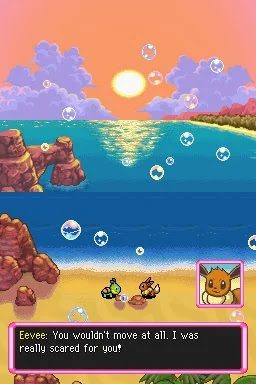
Why I Love Pokemon Mystery Dungeon: Explorers Of Sky

I'm the type of person that would usually prefer gameplay over story. A good story can certainly enhance a game, like many on my Top 100, but it can't usually replace gameplay I'm not into. Emphasis on usually though, because one notable exception has always been the Pokemon Mystery Dungeon series. I don't think the PMD games necessarily have bad gameplay, but I'm definitely not a huge dungeon crawler fan and as such they aren't really my cup of tea. So it's a testament to how incredible Explorers Of Sky's story is that, despite my not loving the gameplay, I would rank it in a heartbeat as one of my ten favorite games ever made, and my favorite Pokemon game of all time.

It took me a long time to get into Pokemon. I had played portions of games throughout my childhood, but I never truly invested myself into any of them until around high school. It was at that point that I was really getting into webcomics, and I discovered the frankly staggering amount of impressively well-drawn PMD comics out there on the internet. I always liked the cute designs of the Pokemon, so learning that there was a game series focused exclusively on them had me intrigued. But I think what really grabbed me was the central dramatic hook of the Pokemon Mystery Dungeon, the concept of being dragged into a new world as a Pokemon, rebuilding your life and forming a community there, saving the world, and proceeding to be immediately forced back home. Reading all those comics peaked my interest in checking out the real McCoy, so I went ahead and played the one people seemed to like the best, and the rest was history.

However, as I mentioned, I'm not exactly enamored with the Mystery Dungeon gameplay loop. I don't think it's bad, per se, but it's not something that would normally keep my interest. I've already voiced my disinterest in procedural generation, and it's easy to see how something like PMD could fall into repetition. That being said, I do think the Pokemon Mystery Dungeon games have quite a bit going for them mechanically that keep me playing. Being a Pokemon game, these entries allow you to recruit other Pokemon into your team, so there's still that addictive "catch-em-all" aspect that defines the series, just injected into a dungeon crawler format. Similarly, there's also type weaknesses and managing the limited amount of moves each Pokemon can hold, all these tried and true elements are able to transition genres really naturally. I also think it helps that Explorers Of Sky in particular is utterly bursting with original content. The postgame is about as long as the main campaign itself, with a ton of secret side dungeons with unique objectives, music tracks, and atmospheres. There's a bunch of unlockable secret chapters that allow you to play through a short campaign as other characters, several of which manage to hit similar emotional highs to that main campaign. And with over 20 playable Pokemon, there's so much replayability since each run you play will feel totally different. In general, I also think Explorers is the best execution of the Pokemon Mystery Dungeon gameplay. It expands on the previous game's mechanics, but doesn't cull too much like Gates does or overcomplicates things like Super does.

But ultimately, the reason I love PMD Explorers Of Sky comes down entirely to the story. This is my favorite video game story of all time, I am not joking. For starters, I just think it's such a well-crafted narrative on its own merits. It's a masterclass in tension, drama, character work, and overall plotting. The first third of the game keeps things fairly slice of life as you get to know the other members of the guild, but there's still engaging conflicts like the rivalry against Team Skull and the looming mystery of Grovyle stealing the Time Gears. Then, Dusknoir appears and the plot starts to thicken, you start to wonder who's really in the right there, leading to that big twist. Dusknoir shoving you and your partner to the bad future, Grovyle revealing his motivations and teaming up with you, and all the plot bombs about your own origins, it's shockingly well-executed. It's twisty enough to genuinely surprise a new player, but it also makes sense, it fits into everything the game had been setting up previously. The oppressive drama within the dark future continues to heighten the stakes, then there's the minor breather as you wrap up loose ends in Sharpedo Bluff, and then there's that incredible final act that resolves every single plot arc in the most powerful way possible, balancing its desparate world-ending stakes with incredibly personal drama (Grovyle's sacrifice, player knowing they'll have to leave once they win). And as I mentioned, the special chapters are also impressively well-written, with the Igglybuff and Grovyle chapters in particular being really effective character studies. When all's said in done, Grovyle in this game might be one of my favorite video game characters solely in terms of writing.

But you know me, I like it when game stories actually take advantage of the medium, and Explorers Of Sky does that wonderfully. It's one thing to have a great story, but Explorers Of Sky does everything in its power to make the player entirely immersed and invested. The obvious way it goes about doing this is by making the main character your self-insert, but you can't just do that and expect instant immersion (looking at you, Forces). Explorers Of Sky puts in the effort to also make all of its characters feel real. The partner and Grovyle are legitimately complex and multi-faceted, which makes it easy to grow genuinely attached to them. Similarly, the crew at Wigglytuff's Guild all have their own unique traits, struggles, and traditions, and the community they form feels really comfy and inviting. And as such, when you're forced into the bad future, it feels haunting, oppressive, and just plain depressing. The most brilliant stroke, of course, is the fact that you have to say goodbye to your partner at the end of the game. It perfectly parallels the fact that, well, the game is over. You will have to say goodbye to these characters because you're reaching the end of the campaign. It's that compelling meta aspect combined with the engaging drama at the core of the story that makes that final goodbye a moment that always brings a tear out of me. 

The fantastic story is all tied together by Explorers Of Sky's stellar presentation. The actual spritework is fairly standard DS fare, but it's incredibly polished and vibrant, and it's elevated by the phenomenal art direction. I love the way Explorers Of Sky's world looks, from the jagged rock cliffs, to the instantly iconic bubble beach, to cozy interior of Wigglytuff's Guild, to Fogbound Lake, to the monochrome future world. Explorers realizes a world inhabitant by Pokemon so effectively, I doubt the game would be as immersive as it is without such strong art direction. And then there's the soundtrack, easily one of my all-time favorites in a video game. It has no business being as emotionally resonant as it is, each theme fits the area and situation pretty much perfectly, heightening the emotions at play in every scene. Throughout most of the game, the music is quite good, with highlights like Drenched Bluff, Wigglytuff's Guild, Treasure Town, Craggy Coast, Foggy Forest, Amp Plains, and Fogbound Lake standing out as especially comfy. But then you get to the final stretch and you are hit with some of the best and most powerful pieces of game music back-to-back-to-back, with Through The Sea Of Time, Temporal Tower, Dialga's Fight To The Finish, Don't Ever Forget, and Memories Returned all punching me in the gut every time I hear them.

It's kinda funny, because when people talk about immersive games, they're usually talking about realistic cinematic games or immersive sims, not a sprite-based dungeon crawler for the DS. And yet, Explorers Of Sky managed to immerse me more than any other game I've played through the sheer strength of its writing, world-building, and character work. I like hanging out in this world, I like going on adventures with my partner Cyndaquil, I like vibing with the Wigglytuff Guild gang, and that's enough to make me overlook any potential gameplay gripes I could've had with it. I tend to think gameplay beats out story, but Explorers Of Sky manages to be the exception that proves the rule.